




A postcode in a city identifies a building. A postcode in the countryside can cover a square mile, several farms and a scattering of cottages that share a name. Satellite navigation will take you confidently to a point in a field and announce that you have arrived, which is a genuinely common experience and an entirely avoidable one.
Rural destinations are where preparation earns its keep most visibly. The work happens the night before, in front of a screen, looking at aerial imagery and working out which of four gates is the one that opens. This page describes how that is done and, more usefully, what you can tell us that solves it in a sentence.
Why rural postcodes fail
Postcodes were designed for delivering post, not for navigating vehicles, and in sparsely populated areas one code can serve a wide scatter of properties. Mapping services resolve that code to a single point, which is often a centroid rather than a door. In hilly or wooded country the difference between the point and the property can be a mile of lane.
House names compound it. Britain has a great many properties called Rose Cottage, The Old Rectory or Manor Farm, sometimes several within a few miles. A search result may confidently return the wrong one, and the error only becomes apparent at a gate that does not open, in the dark, with a passenger in the back. By then the useful moment to check has long since passed.
The preparation that solves it
For any destination we have not driven to before, the approach is checked visually before the day. Aerial imagery shows the actual driveway, the position of the entrance relative to the road, whether there is a gate, and whether the lane is wide enough for a large saloon to pass an oncoming vehicle. Street-level imagery, where it exists, confirms what the entrance looks like from the road.
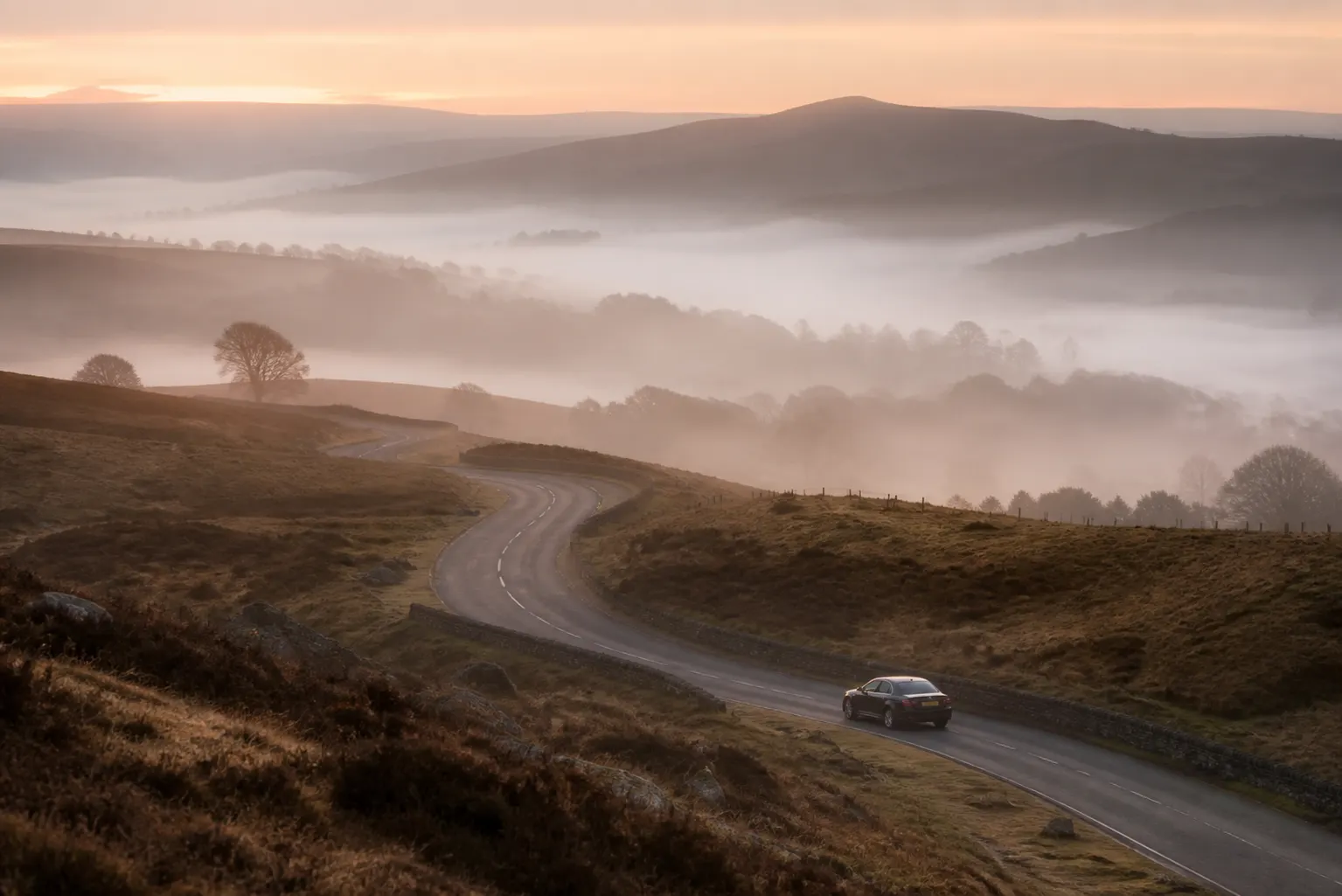
The wider picture matters too. Where is the last place with a mobile signal? Where can the car turn if the lane proves impassable? Is there a passing place near the entrance? A large executive saloon reversing half a mile down a single-track lane in the dark is a genuinely bad outcome, and it is prevented at a desk rather than at the wheel.
- Aerial imagery of the actual entrance and driveway
- Street-level imagery to see what the gate looks like from the road
- Lane width, passing places and where the car could turn
- The last reliable point of mobile signal on the approach
- Whether the surface is metalled, gravel or unmade
- Alternative approaches if the obvious lane is blocked or flooded
- Whether there is anywhere at the property for the car to wait

What3words and precise coordinates
Where a property is genuinely hard to describe, a three-word location reference or a set of coordinates resolves it exactly. These identify a small square rather than an area, which is precisely what a rural gate needs. If you have one for your entrance, send it when you book and it removes the problem entirely. It is the single most valuable line in a rural booking.
The useful refinement is to give the reference for the gate rather than the house. The house is where you live; the gate is where the car needs to stop, and on a large property they can be a considerable distance apart. This single distinction accounts for a good proportion of rural arrival difficulties. Give both if they differ, and say which is which.
Why mobile signal matters
Large parts of rural Britain have patchy or absent mobile coverage, which means a chauffeur may lose both live navigation and the ability to call you at exactly the moment they need either. The countermeasure is offline preparation: the route known rather than followed, and the final approach understood before signal disappears. Chauffeurs who work rural routes carry the last few miles in their heads rather than on a screen.
It also affects how you should think about contact. If you are expecting a car at a remote property, do not assume you will be reachable by phone at the last moment. Agree the arrangement beforehand — where the car will stop, what to do if it cannot get in — so that nothing depends on a call that may not connect.
Gates, codes and estates
Gated properties introduce a category of problem that no mapping solves. A code that changes, an intercom nobody answers, a keeper's number that is not being picked up, or a gate that opens onto a service drive rather than the house. Each of these is straightforward if known in advance and a serious delay if discovered on arrival. None of it is guessable from the outside of a gate.
Large estates and hotels with several entrances are the other common case. The main gate may be locked outside certain hours, or reserved for an event, with a different entrance in use. Anything you know about how access actually works at your destination is worth passing on, because it is frequently information that exists nowhere else. Estates in particular change their arrangements for events without telling anybody.
- The gate code, or who to contact if a code is needed
- Which entrance is actually in use, if there are several
- Any hours when the main entrance is locked
- The name of a keeper, housekeeper or estate office if relevant
- Whether a car can reach the door or must stop short
- Anything about the surface that affects a low-slung vehicle
Winter, weather and rural roads
Country roads change character with the weather in a way that main roads do not. Fords rise, lanes flood at known points, fallen branches close a route entirely, and untreated hills become impassable to a rear-wheel-drive saloon well before the main network is affected. Timings for rural journeys in winter are built with more margin for exactly this reason. A closed lane in the countryside can add a genuine hour.
If your destination has known local difficulties — a hill that becomes impossible after snow, a lane that floods, a ford that is not always passable — that is genuinely valuable information. It may change the vehicle recommendation, the route or the timing, and it is the kind of thing only someone who lives there knows. Two sentences from you can save an hour on the day.