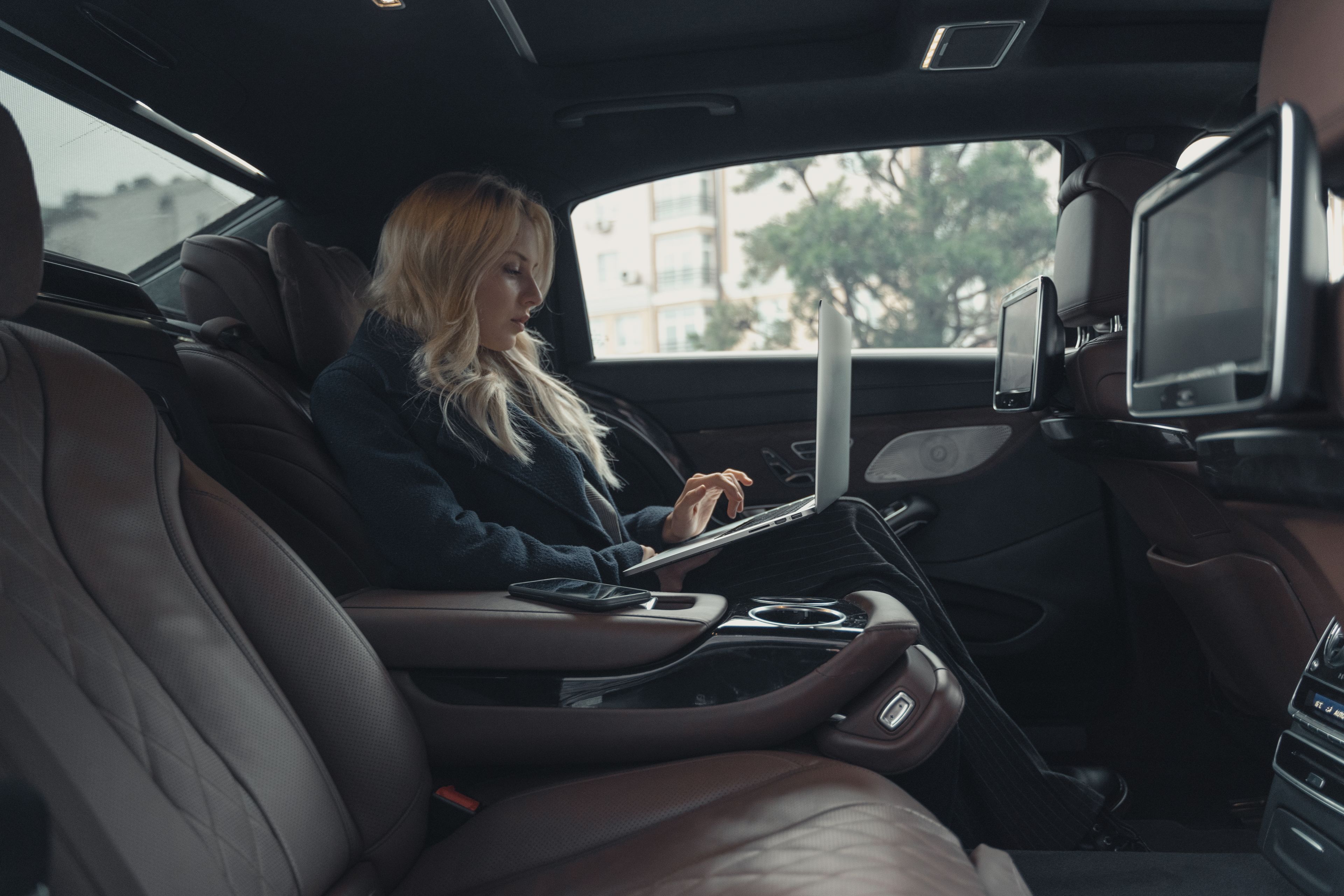






For a great many passengers, the car is the only genuinely private hour in the day. It sits between one meeting and the next, it has no colleagues in it, and the phone works throughout. So the question of whether a sensitive call can be taken in the back of a chauffeur car is not idle — for some people it determines whether the booking is worth making at all.
The honest answer has two parts. Professionally, discretion is a core part of the job and is taken seriously by anyone doing it properly. Physically, a car is a small enclosed space and there is a person in it. Both things are true, and the sensible approach is to rely on the first while taking a few practical steps that acknowledge the second.
What discretion means in this trade
A professional chauffeur treats everything heard in the car as though it were not heard. They do not repeat it, do not react to it, do not ask about it afterwards, and do not mention who was in the car or where they went. This is not a courtesy extended to important passengers; it is the baseline behaviour of the job, applied to everyone, and it is one of the things that separates chauffeur work from ordinary driving.
In practice it shows up as an absence rather than a presence. No follow-up questions about the meeting you just left, no comment on the name you mentioned, no knowing look in the mirror. Chauffeurs working at this level spend their days adjacent to other people's business and have long since stopped finding it interesting. Indifference, in this particular job, is a professional qualification rather than a failing.
What the driver can actually hear
It is worth being clear-eyed rather than reassuring here. In an executive saloon at motorway speed, with music on and a partition-free cabin, your half of a phone call is audible to the driver. In a flagship saloon the acoustics are better but the physics are the same. If the call is one where being overheard would matter, that is the assumption to start from.
The far end is a different matter. Held to your ear, the other party is generally inaudible from the front. Speakerphone changes that completely and puts both halves of the conversation into the cabin, which is worth remembering before you press the button out of habit while looking for a document. If you must use it, a short warning to the chauffeur means the music comes up rather than down.

Practical steps that improve privacy
There are several straightforward things that make a real difference, and none of them requires an awkward conversation. Most passengers who take sensitive calls regularly settle into two or three of these without thinking about it. They are worth listing because passengers tend to assume the only options are accepting the risk or not making the call at all, when in practice the middle ground is wide and easy to reach.
If a call is genuinely sensitive, the most effective single measure is to say so beforehand. Chauffeurs will raise the music slightly, close the front vents that carry sound, and stop any conversation entirely. It is a normal request and asking it is not remotely awkward. Chauffeurs would far rather be told at the outset than work out halfway through that the conversation was not meant for them.
- Say at the start of the journey that you will be taking calls
- Use the handset rather than speakerphone where you can
- Wired or Bluetooth earphones keep the far end entirely private
- Ask for the partition to be raised where the vehicle has one
- Ask for the radio up a notch — it masks more than you would expect
- For the most sensitive calls, ask the chauffeur to stop and step out for a few minutes
Vehicles with a partition
Some larger vehicles and certain prestige cars have a physical partition between the front and rear compartments, and where one exists it is the most complete answer available. Raised, it makes the rear cabin genuinely separate and removes most of the doubt. If this matters to you, ask about it at the point of enquiry rather than assuming it, because it is a feature of specific vehicles rather than a general one.
Luxury MPVs often achieve something similar through distance rather than glass: the rear row is further from the driver, and a conversation at normal volume does not carry forward well. For a group discussion in transit, that separation is often more useful than a partition in a saloon. It also means the party can talk to each other properly, which a raised division does not always allow.
Recording, dashcams and devices
Many vehicles carry a forward-facing dashcam for insurance purposes, and some record audio. If that matters to you, ask directly before the journey — it is a reasonable question and you should expect a straight answer, including the ability to have interior audio recording disabled or the device switched off for your booking. Asking is not an accusation, and no professional operator treats it as one.
The same applies to any other device. If you are travelling on business where recording would be a genuine problem, say so at the point of booking so the vehicle can be selected and prepared accordingly, and so the position is confirmed to you in writing rather than assumed on the day. A verbal reassurance at the kerb is worth considerably less than a line in a confirmation.
- Whether a dashcam is fitted, and whether it records audio
- Whether interior audio can be disabled for your booking
- Whether the vehicle carries any other recording device
- Who has access to footage, and how long it is retained
- Confirmation of all of this in writing before you travel
Legal, medical and personal conversations
Not every sensitive call is a business one. People take calls from hospitals, solicitors and family in the back of cars all the time, often on the worst day of a difficult month. A chauffeur will recognise that instantly, turn the music up, stop talking, and simply drive. If you need a moment afterwards before arriving, saying so is enough.
If a conversation is likely to be distressing, there is no obligation to explain anything. Asking to pull over somewhere quiet for ten minutes is a completely normal request and will be handled without curiosity or comment. Arriving composed is usually worth the delay. Chauffeurs see more of this than anyone outside the trade would guess, and the right response has long since become second nature: stop, say nothing, and wait.