







Ask a Glaswegian how long it takes to get to the airport and you will be told fifteen minutes, which is true about as often as it is not. The M8 runs from the city almost to the terminal and it is a genuinely quick road when it is moving. When it stops, and it does stop, there is nowhere useful to go instead.
So the honest approach to a departure collection here is to plan for the road as it behaves rather than as it behaves at its best. What follows is how we arrive at a time: the airline's requirement first, then the drive at your particular hour, then the walk inside, then a margin proportionate to the route you are actually taking.
The airline window, then everything else
Airlines publish their own guidance on how early to be at the airport, and it differs by carrier, by cabin and by destination. Bag drop closing and gate closing are separate again, and also the airline's own. We establish what applies to your flight at the point of quoting, rather than issuing everybody the same figure and hoping that it fits.
With that fixed, the calculation runs backwards. What time must you leave to be inside by then, given the road at that hour, the walk from the kerb, and a sensible allowance for something going wrong along the way? Answering in that order produces a very different figure from starting with the drive and adding a bit on the end.
The M8 and where it hurts
From the city centre the run out to junction twenty-eight is fifteen to thirty minutes in ordinary conditions. The motorway carries an enormous volume through the middle of Glasgow, and the Kingston Bridge is the single point at which that volume is most concentrated. When it slows, the effect reaches back a long way in both directions.
Coming from the north or east, the M8 does the work all the way in, and the same constraint applies. From Ayrshire and the south the M77 feeds in, which is generally easier. From Loch Lomond and the west the A82 and Erskine Bridge offer an approach that avoids the city entirely, and on a bad day that is the more reliable option.
Weekday mornings from about seven and evenings from about four are when the margin needs to be real rather than nominal. Weekends are usually kinder, though football at either of the city's grounds and events at the arena reshape the roads in ways the calendar rather than the traffic report will tell you. We look before we set a time.
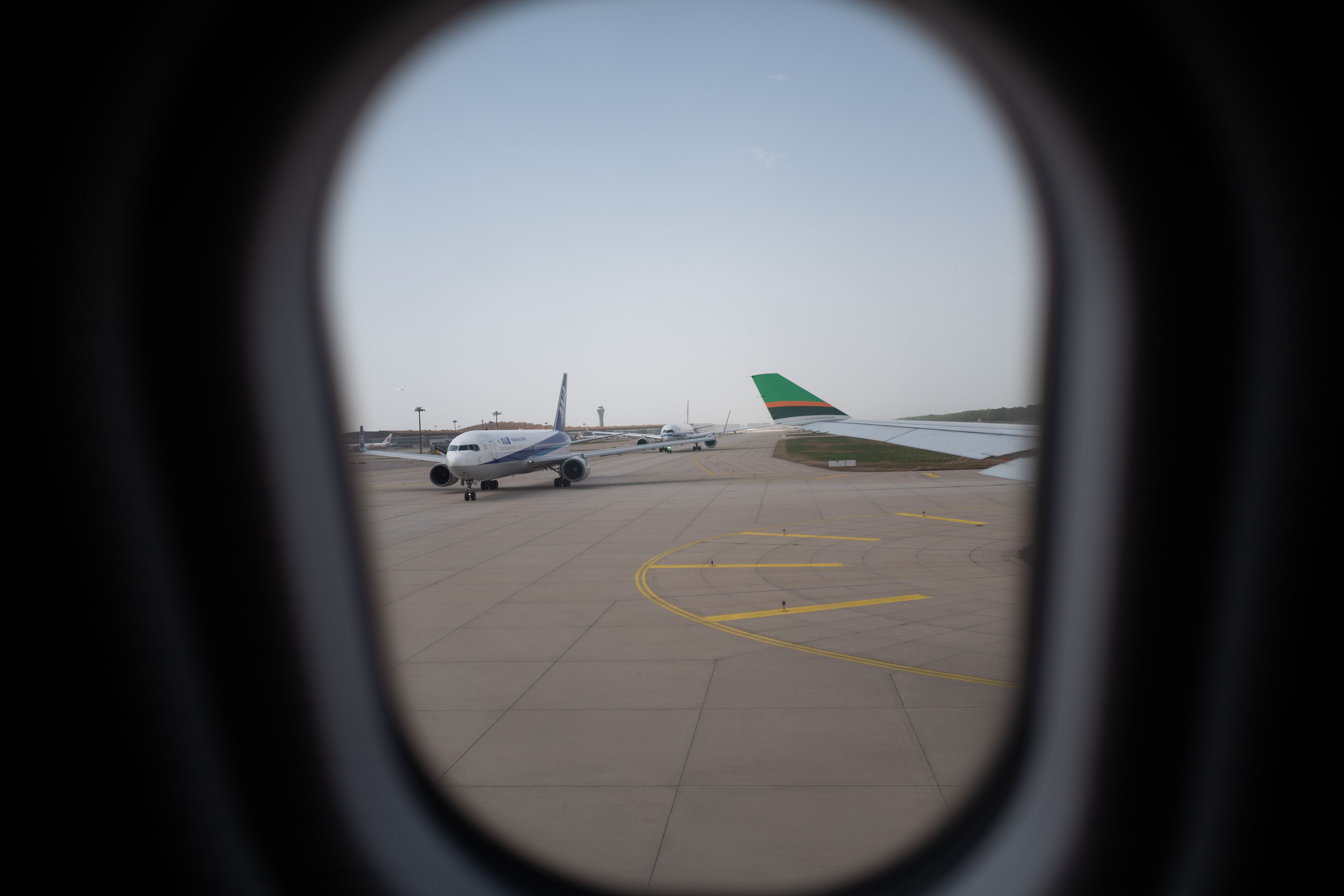
Inside the terminal
The building is compact and set-down sits close to the entrance, so the internal distances here are modest. For a passenger with cabin baggage and a boarding pass on a phone, the time between stepping out of the car and reaching security is short. That is a real advantage of a mid-sized airport and it is worth counting properly.
It is easier to overspend the advantage than to bank it. Peak departure banks in the early morning concentrate a great many people at the desks at once, golf parties checking clubs take longer than they expect, and families with a fortnight of cases move at their own pace. The allowance is set to the party, not to the floor plan.
- Airline arrival guidance for that specific flight and cabin
- Your starting postcode, which decides the approach entirely
- The hour and day, plus any football or arena event
- Hold bags, golf clubs or skis and the total piece count
- Any second collection address on the route
- A margin sized to the Kingston Bridge, not the final mile
Three starting points, three answers
From a hotel in the city centre on a quiet Sunday, the drive is short and the collection time is dominated by the airline window rather than by the road. From the same hotel on a Monday morning, the identical journey wants a noticeably larger allowance, because the motorway is carrying the whole city at once. The distance has not changed by a yard.
From Loch Lomond or Argyll the arithmetic changes completely. The drive is longer but more predictable, and the approach can avoid the city altogether. From Ayrshire, the M77 is usually well behaved but the final junctions onto the M8 are not always. Each of those deserves its own figure rather than a shared one applied for convenience.
Early flights and long-haul mornings
The first departures of the day are the easiest journeys we make from Glasgow. The roads before six are quiet in every direction, the drive is quick and the timing is reliable. We still build in a margin, because an early flight offers no second chance if a stretch of motorway has been closed overnight for works nobody advertised.
The transatlantic departures are the opposite case. They tend to leave in the late morning or early afternoon, which places you on the road after the peak but with a fuller terminal and a longer process at the desks. Those bookings carry a wider allowance on both counts, and it is not padding for its own sake.
The morning itself
The car is outside before the agreed time, not at it, so nobody is waiting on anybody. The route has been checked that morning, and if the bridge is already causing trouble your chauffeur will have chosen the alternative before you have closed the front door. Luggage goes into the boot while you are still finding your passport.
At the airport the closest available set-down is used, the cases come out and the handover takes moments. Forecourt arrangements are the airport's own and are chargeable; we handle them and account for them in the written quotation. Cars come from our own fleet and from a vetted network of professional chauffeur operators across the west of Scotland.