








Gatwick departures are usually easier to time than Heathrow ones, for the simple reason that the airport is smaller and the approach is more direct. The complication lives elsewhere. Almost every journey to Gatwick from London or the Home Counties touches the M25, the M23 or both, and those two roads have moods rather than schedules.
So the useful question is not how long the drive takes on a good day. It is what happens to your morning if the M25 anticlockwise stops moving between junctions 8 and 9, which it periodically does. This page sets out how we build a collection time that absorbs that rather than one that pretends it will not happen.
Two terminals, two approaches
The North and South Terminals have separate forecourts and separate drop-off arrangements, and although the signage from the M23 spur is clear, the decision point comes late. Being sent to the wrong one is not a disaster, since the shuttle takes only a few minutes, but it is time you would rather not spend with a case in each hand. We set the terminal at booking from your flight details and re-check it against your boarding pass.
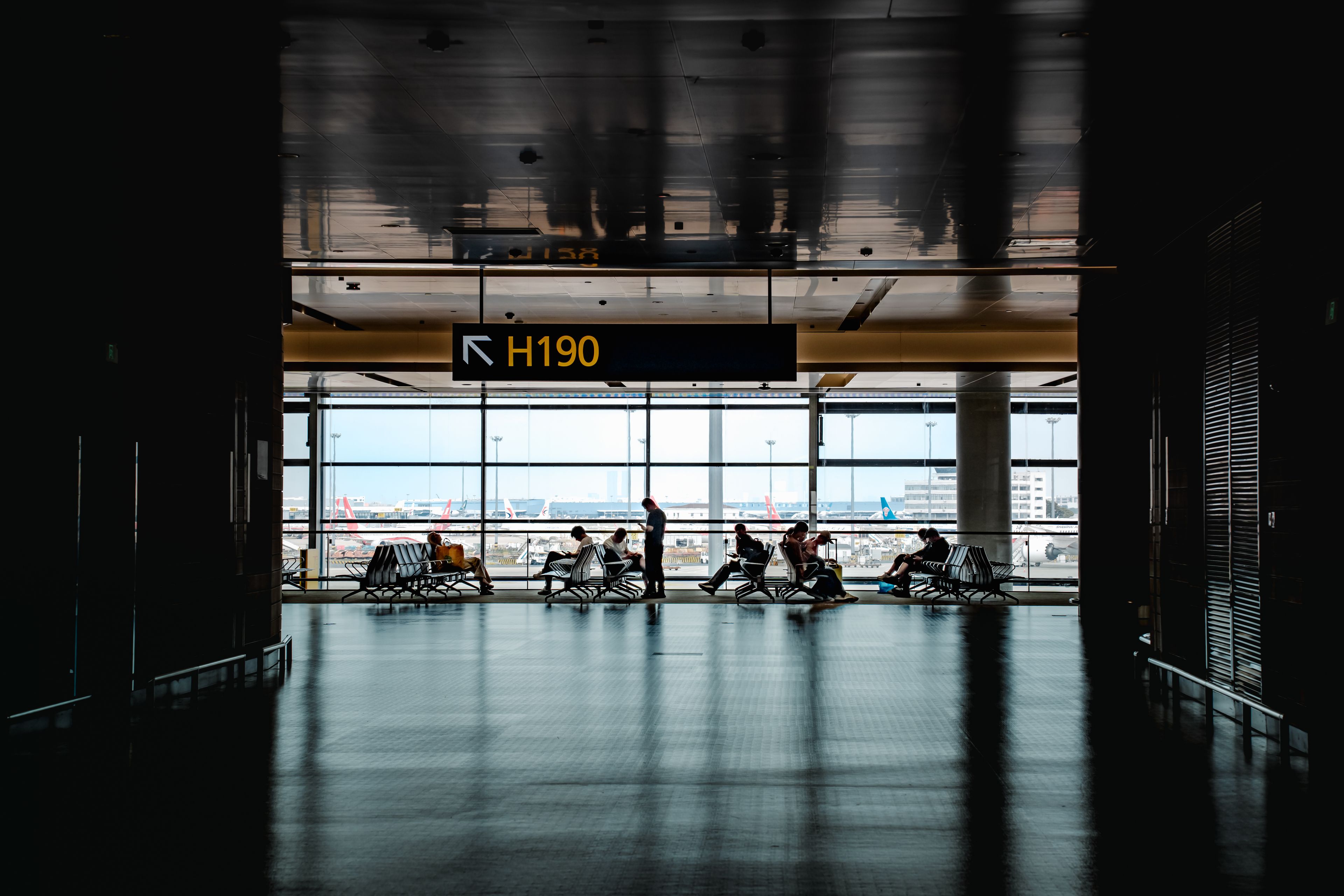
Inside, both buildings are manageable. Neither has the long internal distances of Heathrow Terminal 5, so the walk from the kerb to bag drop is usually short. That does trim a little from the overall allowance, but the saving is modest and we would rather bank it than spend it.
The road, and the M25 problem
From central London the drive is typically an hour to an hour and a half depending on traffic, running out through south London or around the M25 to the M23 spur. Neither route is reliably faster than the other; it depends where you start and what the day is doing. From Surrey, Sussex and much of Kent the journey is often shorter and considerably more predictable.
The M25 is the variable that matters. The stretch between the M23 junction and the Dartford crossing carries very heavy traffic and reacts badly to incidents, and an accident there can add an hour with no warning and no useful diversion. The M23 itself is usually well behaved. Local approaches through Crawley and Horley exist as a fallback but they are slow, so they rescue a journey rather than improve it.
Time of day does most of the work. Weekday mornings from about seven, weekday evenings from about four, and Friday afternoons in particular all deserve an extra allowance. Early Sunday mornings and late evenings usually run cleanly. We set the collection for the hour you are travelling rather than applying a single figure to every booking.
Building the time backwards
The airline decides when you should be in the terminal, and that guidance varies by carrier, cabin and destination. We confirm it against your specific flight when we quote rather than assuming a standard. From there we add the realistic drive time for the day and hour, the walk from drop-off to bag drop, and a margin sized to how much the route could plausibly go wrong.
A useful sanity check is to ask what happens if the drive takes thirty minutes longer than expected. If the answer is that you still make bag drop comfortably, the time is right. If the answer is that you are running, it is not. That single question resolves most disagreements about departure timings more quickly than any table of averages.
- The airline arrival window for your flight, confirmed at booking
- North or South Terminal, checked against your boarding pass
- Realistic drive time for that day and hour, not the best case
- An allowance sized to the M25 risk on your route
- Hold bags or cabin only, and the total number of pieces
- Anyone travelling who needs more time through the building
Very early and very late departures
Gatwick runs a substantial early morning departure bank, which means a great many collections between three and five in the morning. The roads at that hour are genuinely quiet and the drive is usually quick, but the airport is not quiet at all, and bag drop queues at four in the morning can be longer than at nine. Plan for the terminal to be busy even when the motorway is empty.
Late evening departures are the opposite case. The airport thins out but the roads may not have, particularly on a Friday. Either way your chauffeur arrives ahead of the agreed time, and we would rather you sat in the car for five minutes than stood on the pavement wondering.
How the collection actually runs
The car is at your address before the agreed time. Luggage goes into the boot, and if there is more of it than a saloon will take, that was settled at booking rather than at the kerb. The route is checked that morning, and if the M25 has already gone wrong your chauffeur will take the alternative without needing a conversation about it.
At the airport, your chauffeur drops you at the forecourt for your terminal, unloads the cases and, if you would like, walks them as far as the doors. Forecourt access at Gatwick is the airport's own arrangement and is chargeable; we deal with it and include it in the written quotation so nothing needs settling on the day.
Cars come from our own fleet and from a vetted network of professional chauffeur operators, which is how very early starts across Surrey, Sussex, Kent and London are covered without compromise. You will know the vehicle and the chauffeur in advance rather than meeting a stranger in the dark.
When plans change
Flights move. If yours is retimed, send us the new details and the collection moves with it, subject to whatever the written terms set out about changes. If you are checking in online and travelling with cabin bags only, tell us, because it genuinely changes the time we would recommend and there is no sense in getting you there early for a queue you will not join.
Everything is arranged over WhatsApp or email, so the agreed time, the vehicle and the terms are all written down and easy to check. That matters most at five in the morning, when nobody wants to reconstruct a conversation from memory.