

Skip to content
Luxury ChauffeursUnited Kingdom
Electric vs Petrol Chauffeur Cars for Long Journeys

Etiquette & Practical

Electric vs Petrol Chauffeur Cars for Long Journeys

7 min readUpdated 9 January 2026

Quoted individually. Share the outline and we reply with a written price — no rate card, no obligation.

Topic
Etiquette & Practical
Reading
7 min read
Updated
9 January 2026
Coverage
London & the whole UK

For a day of appointments in a city, the choice barely arises: an electric car is quiet, smooth and entirely suited to the work. The question becomes real when the journey is three or four hundred miles, the schedule is tight, and the destination is somewhere the charging network was not designed around. That is where the two technologies genuinely diverge.

This is a practical comparison rather than an argument. Both types are in regular chauffeur use across Britain, both do the job well in the right circumstances, and the sensible approach is to match the vehicle to the route rather than to a principle. Here is what actually differs once the mileage climbs. Both answers are legitimate; only one of them suits any given day.

Real-world range, not the brochure figure

Official range figures are laboratory numbers and every experienced operator discounts them. On a motorway at legal cruising speed, with a full complement of passengers and luggage, climate control running and possibly cold weather, real usable range is meaningfully lower than the headline. Winter is the biggest single variable, and it can be substantial. A December run north is a different proposition from the same route in June.

That does not make long electric journeys impractical; it makes them plannable rather than assumable. A route is worked out with a charging stop in it at a known, reliable location, and the timings include that stop. What causes problems is treating the brochure figure as a promise and discovering the shortfall somewhere on the A9 in February. Planned, it is a stop; unplanned, it is a problem.

The charging stop as part of the day

A rapid charge on a long route is not a two-minute affair, and it is worth thinking of it as a scheduled break rather than an interruption. On a four-hour journey, most passengers would take a break anyway, and combining the two costs less than it sounds. Where it becomes a genuine problem is on a journey with a hard deadline at the far end and no slack in the plan.

Reliability of the network is the harder issue. Chargers are occupied, out of service, or slower in practice than their rating suggests, and coverage thins considerably in rural Scotland, mid-Wales and parts of the West Country. A plan with a single charging point in it is fragile; a plan with an alternative identified is not. The second charger is the one that makes the first one safe to rely on.

  • Distance against realistic winter range, not the official figure
  • Whether the route has reliable rapid charging with alternatives nearby
  • Whether the schedule has room to absorb a stop, or a delayed one
  • Passenger and luggage load, which reduces range noticeably
  • Charging at the destination, and whether it is actually available to you
  • The return leg, which is where plans most often come unstuck

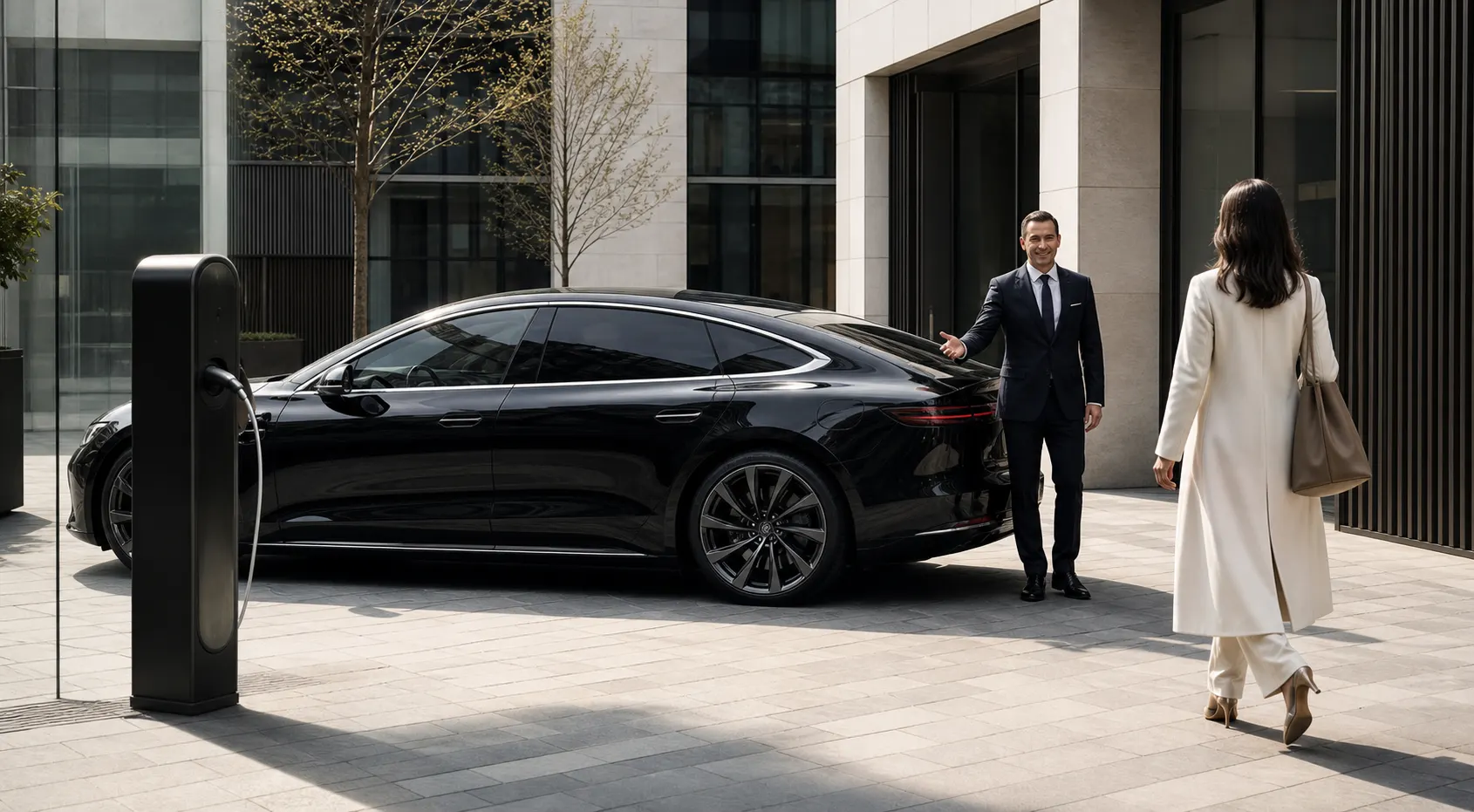
Electric vs Petrol Chauffeur Cars for Long Journeys — illustrating the guide

What electric does better in the car

The passenger experience in a good electric saloon is genuinely superior in specific ways. There is no engine noise at all, which changes the character of a long journey and makes calls and conversation easier. Acceleration is smooth and continuous, without gearchanges, which matters more over four hours than it does over four miles. Passengers who work in the car notice the difference within the first half hour.

Stationary comfort is the underrated advantage. Waiting outside a venue for an hour with the cabin at temperature costs an electric car nothing but battery, silently, with no exhaust and no vibration. In a combustion car the same thing means running the engine, which is worse for everyone including the people on the pavement. On an evening of long waits outside a venue, that alone can decide the vehicle.

What petrol and diesel still do better

Refuelling takes a few minutes and can be done almost anywhere, which is the whole of the argument and it is a strong one. On a journey where the timing is critical, where the route crosses sparse territory, or where the day may extend unpredictably, that flexibility has real value. A car that can simply keep going is worth a great deal when the schedule moves.

Diesel in particular remains efficient on sustained motorway running, and modern examples are quiet enough that the noise advantage of electric is less pronounced at a cruise than around town. For a repeated long-distance route with tight timings, combustion is still frequently the more reliable operational choice. It is not a nostalgic preference so much as an acknowledgement that the charging network is still uneven outside the main corridors.

Choosing for your particular route

The decision is usually straightforward once the specifics are on the table. Urban and regional work, days with lots of waiting, and routes under a couple of hundred miles suit electric comfortably. Long trunk routes with hard deadlines, remote destinations, and days whose finishing time is genuinely unknown suit combustion better. Most bookings fall clearly on one side or the other once the destination and the deadline are known.

The middle ground is where the conversation is worth having. A run to a country house in Yorkshire with an overnight stay may work well electrically if there is charging at the property, and not at all if there is not. Tell us the destination properly and the answer usually becomes obvious in a sentence. Charging at the far end changes the calculation more than anything else does.

  • City days with frequent stops and long waits: electric, comfortably
  • Regional round trips within moderate range: electric, with a checked plan
  • Long motorway runs with a hard deadline: combustion, usually
  • Remote rural destinations with sparse charging: combustion
  • Overnight stays where the property has charging: electric works well
  • Days with an unknown finishing time: combustion, for the flexibility

Asking the right question when you book

The unhelpful question is whether we have electric cars. The useful one is whether an electric vehicle suits this journey, on this date, with this schedule. That invites a real answer rather than a yes, and it produces a recommendation you can rely on rather than a car you may regret at a service station. The difference between the two questions is roughly the difference between marketing and advice.

If having an electric vehicle matters to you for its own sake, say so directly and it will be treated as a requirement rather than a preference. Where it is not the right tool for a particular route, we would rather explain why than take the booking and hope the charging network cooperates. Hoping is not a plan, and it is your journey that would absorb the consequence.
In Short

Key Points

  1. 01Discount official range figures heavily for motorway speed, load and winter
  2. 02Treat a charging stop as a scheduled break, and identify a backup charger
  3. 03Electric is quieter and far better during long stationary waits
  4. 04Combustion still wins on tight deadlines, remote routes and unknown finish times
  5. 05Ask whether electric suits this route rather than whether it is available

Why Luxury Chauffeurs

Why Choose Luxury Chauffeurs

  • 01

    Held, not hailed

    The car is reserved against your name for the whole booking. Nothing is pooled, nothing is reallocated, and no algorithm decides who arrives at your door.

  • 02

    Priced in writing

    Distance, duration, vehicle and timing are worked out before you commit, then confirmed in writing, so the figure you agree is the figure for the journey.

  • 03

    London and beyond

    A short run across Mayfair and an unhurried drive to the Highlands are arranged with the same care, by the same people, under one booking.

  • 04

    Discretion as habit

    Unbranded vehicles, chauffeurs who speak only when spoken to, and a rear compartment where a confidential call needs no lowering of the voice.

Luxury Vehicles

Choose Your Chauffeur Driven Car

From an executive saloon to a Rolls-Royce. Model, colour and specification are subject to availability and booking confirmation.

Four Steps

How Booking Works

Chauffeur booking with us is a conversation rather than a checkout. Every journey is priced individually.

  1. 01

    Tell us the journey

    Send the date, the addresses and the shape of the day on WhatsApp, or use the journey planner. There is no obligation and no card details are taken to get a price.

  2. 02

    We quote in writing

    You receive a written quotation covering the vehicle, the timings and everything included — no estimates that move later, and no surge pricing.

  3. 03

    The car is held

    On confirmation a vehicle and a named professional chauffeur are assigned to your date, and the terms are put in writing.

  4. 04

    Your chauffeur arrives

    Briefed on the route, the access and the waiting arrangements before the day, so nothing is decided at the kerb.

Executive chauffeur travel

Corporate & Business

Business Travel Across Britain

Corporate chauffeur work runs to a diary rather than a postcode. Meetings overrun, a signing drags past six, and the airport leg still has to make check-in. Because the vehicle is committed to your booking, a revised plan costs a message rather than a fresh price. Accounts can be arranged so individual travellers never handle payment, and the paperwork is kept plain enough for a finance team to reconcile without chasing anybody.

The rear compartment is treated as a working space. Cabins are quiet enough for a confidential call, papers can stay open on the seat between stops, and chauffeurs understand that what is overheard is not repeated. Roadshows, board visits and conference movements involving several cars are coordinated centrally, so one person holds the schedule and one thread carries every change to it.

Airports

Airport Chauffeur Connections

Met in arrivals with a name board, luggage carried, and departures planned around your check-in.

Before You Send

What to Tell Us

None of it is compulsory. The more you include, the sooner we can reply with a firm written price rather than a question.

  1. 01

    Where and when

    Pickup and destination addresses, the date, and the time you need to arrive rather than leave.

  2. 02

    Who is travelling

    Passenger numbers, large cases and cabin bags, and the ages of any children so we fit the right seats.

  3. 03

    The shape of the day

    One journey, a return, or a car held for several hours. Say if the timings might move.

  4. 04

    Flight or event details

    A flight number lets us plan around the published schedule; an event name tells us which gate and which traffic plan.

  5. 05

    Vehicle preference

    A category is enough — or ask us to recommend one for the party and the distance.

  6. 06

    Anything else

    Accessibility requirements, a preferred route, a stop on the way, or a quiet car with no conversation.

Professional Chauffeur Standards

The Standard We Hold

What a premium chauffeur service should mean in practice, rather than in a brochure.

  • Vetted professional chauffeurs

    Every chauffeur is licensed, insured and vetted before they drive for us. They are briefed on your journey in advance and dressed for the occasion.

  • Discretion by default

    Vehicles carry no branding. Your chauffeur speaks when spoken to, and what is discussed in the back of the car stays there.

  • Immaculate vehicles

    Current-generation cars, valeted before every journey, with still water and charging in the rear compartment.

  • One point of contact

    The same person handles your enquiry, your quotation and your booking, so nothing is explained twice.

A professional chauffeur waiting beside a luxury car

Where We Travel

Nationwide Chauffeur Service

London is where most of our work begins, but a chauffeur can be arranged to and from any address in the United Kingdom.

Get a Quote

Request a Personalised Quotation

Every journey is priced individually against distance, duration, vehicle and timing. Send the outline and we will reply with a written quotation.

Frequently Asked

Related questions

What This Page Covers

  • electric chauffeur car long journey
  • electric vs petrol chauffeur
  • ev range uk motorway
  • electric executive car
  • long distance chauffeur uk
  • chauffeur car charging stops
  • ev chauffeur service

Related

Continue Reading

WhatsApp

+44 7775 554848

The quickest way to reach us, day or night.

Email

info@luxury-chauffeurs.uk

For itineraries, accounts and anything with an attachment.

Coverage

London & the whole UK

Quoted individually, in writing, before anything is confirmed.

A chauffeur-driven journey at dusk

Arrange Your Chauffeur

Where Will Your Next Journey Take You?

Tell us the date, the destination and the mood of the day. We will reply with a written quotation and a chauffeur assigned to you.

Get a QuoteWhatsApp