






Large exhibition venues are small towns with one entrance problem each. They sit beside motorways or on regenerated docks, they hold tens of thousands of people for three days, and the roads around them behave normally for fifty weeks of the year and not at all during a major show. Everything difficult about attending one follows from that.
This guide covers the parts a delegate or an exhibitor actually has to solve: where a car can set down, what to do with stand materials, how to run several days from a hotel without losing a morning each time, and how to handle speakers or senior visitors arriving from elsewhere. Passes and stand bookings are your own arrangement.
How the big venues handle arrivals
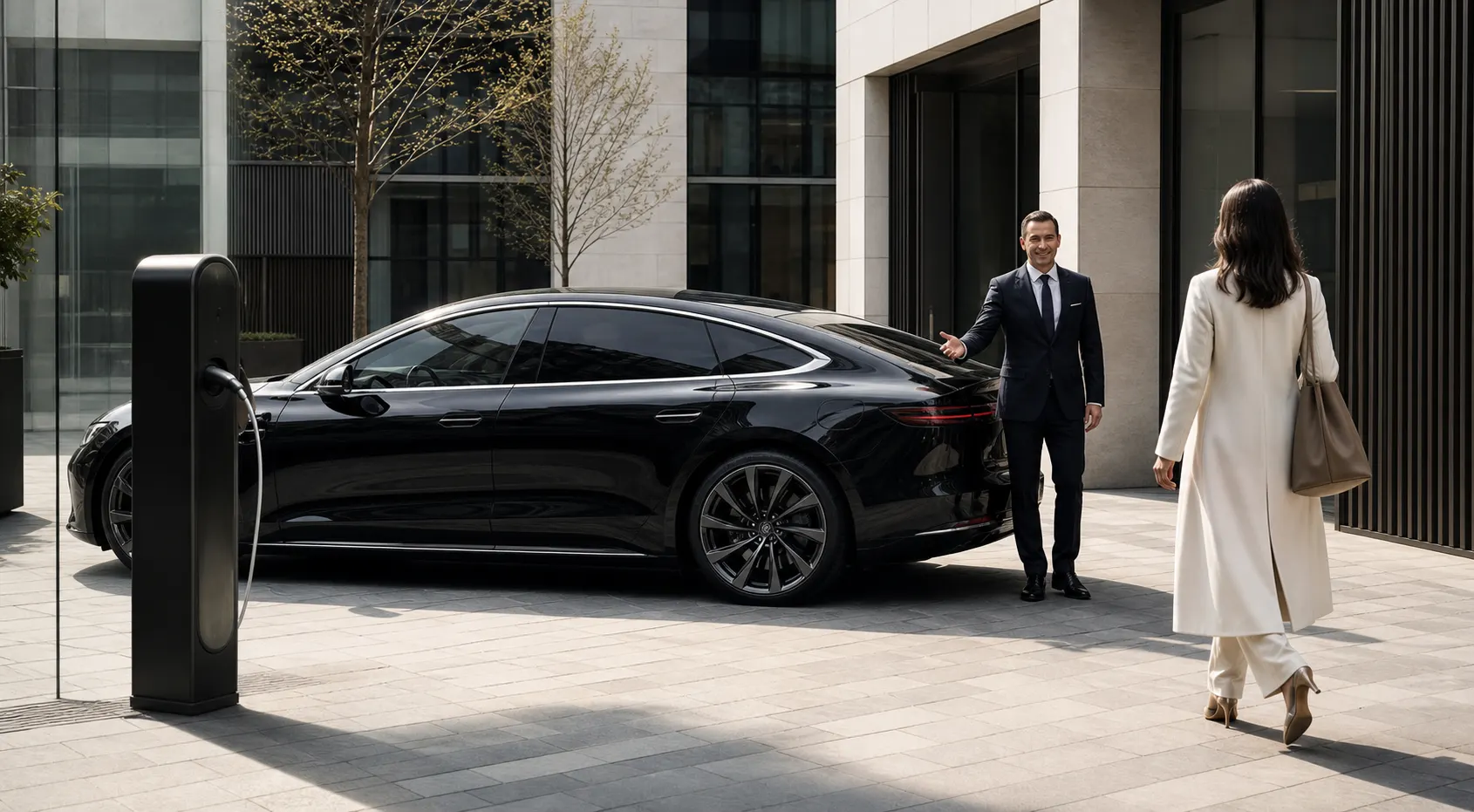
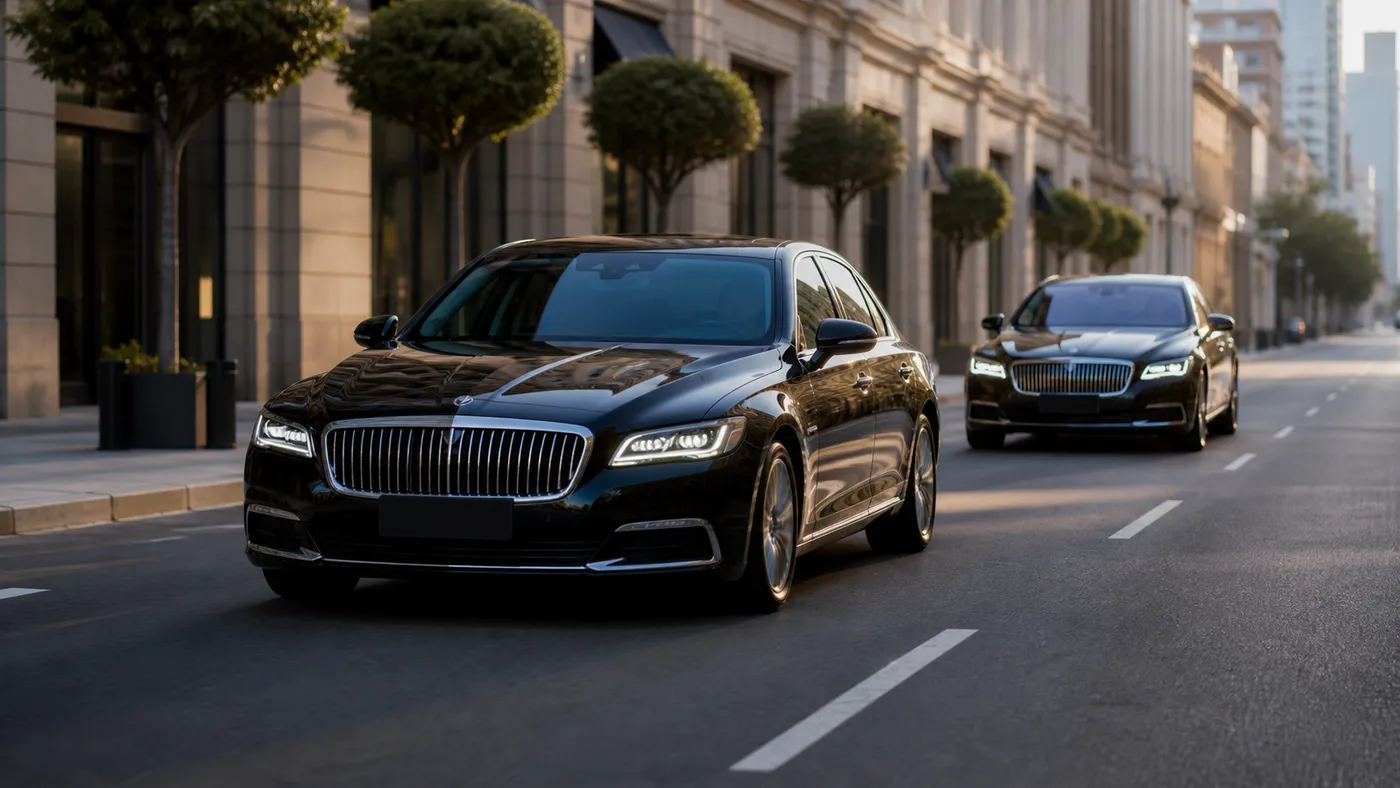
The major venues all operate defined set-down areas, and they are rarely at the door of the hall you want. Car parks are extensive and distant, taxi ranks form early, and on the busiest mornings the approach roads back up well before the halls open. A chauffeur's advantage is a set-down close to an entrance and then leaving, which is what those layouts are designed for.
Which entrance matters. A venue with several halls may have several entrances a considerable distance apart, and arriving at the wrong one costs a walk that can take a good ten minutes indoors. Send us the hall or the stand number rather than only the venue name, and the approach can be planned to the right end of the building.
Exhibitors and everything that must be carried
Exhibiting is a logistics problem before it is anything else. Stand graphics, samples, literature, a laptop, a stock of giveaways and a suit bag all have to reach the hall, and the arrangements for build-up and breakdown are set by the venue and the organiser, with their own timings and access routes.
Chauffeur cars are not a freight solution and we would not pretend otherwise; heavy stand build goes by carrier. What a vehicle does well is carry the things that must not go astray, along with the people carrying them, and be available at the end of the day when nobody wants to be handling boxes on a station platform.
- Which hall and which entrance, not only the venue
- Build-up and breakdown access times from the organiser
- What travels in the car and what goes by carrier
- A suit bag or change of clothes for the evening
- Anything fragile that should not stay on a stand overnight
- Where the vehicle can wait during breakdown

Running several days from a hotel
Multi-day shows are usually run from a hotel near the venue or in the nearest city, and the daily run between them is the same journey repeated with entirely different traffic each time. The first morning is slowest because everybody arrives at once; the last afternoon is slowest in the other direction for precisely the same reason.
Agree each morning's departure the night before rather than fixing one time for the week. Show days start differently: a keynote on the first morning, a quieter second day, a breakdown on the last. Where the car is held across the days, the evening use comes with it, which for most exhibitors means dinner with nobody driving.
Delegates, sessions and the middle of the day
For a delegate the transport problem is concentrated at the ends of the day, since the middle is spent inside the building. That makes a straightforward pattern: set-down in the morning, the vehicle released or waiting, and a collection when the sessions finish. The complication is that sessions overrun and the useful conversations happen afterwards.
Treat the collection as a window rather than a time. It is the same principle as any event, and it matters here because the most valuable twenty minutes of a conference is usually the twenty minutes after the last session, when the room empties slowly and people finally talk to each other properly.
Speakers, and visitors who come for two hours
Senior visitors and speakers frequently attend for a fraction of the event: in from an airport or a station, on stage, a lunch, and away again. That itinerary has no slack in it and one hard deadline in the middle, so it is planned backwards from the moment they are due on rather than forwards from their arrival.
Where somebody is arriving by air, we ask for the flight number and the scheduled arrival and allow generously for the terminal, adjusting to the published arrival rather than the timetable. Where a car waits while they are on stage, it waits at a point it can leave from quickly, since the departure is usually the tighter half of the visit.
Leaving on the last afternoon
Breakdown day produces the worst traffic of the show, because exhibitors, delegates and vehicles all leave within the same few hours while the venue is admitting lorries at the same time. A departure planned for the moment the halls close is a departure planned into the middle of exactly that.
Either leave before the close, if your commitments allow it, or plan to wait somewhere civilised for an hour. Everything is arranged over WhatsApp or email with a written quotation covering the days and hours beforehand, and the collection point for the last afternoon is best agreed on the morning of it rather than in advance.
- An earlier departure, if your stand allows it
- A collection point away from the main exit route
- Somewhere to wait comfortably while the roads clear
- A plan for anyone leaving separately for a flight
- Time for breakdown, which always runs over