




Chauffeured travel comes with a set of conventions that nobody ever writes down, which leaves people guessing. Should you make conversation or not? Is it rude to take a call? Where are you supposed to sit? None of it is difficult, but the absence of guidance means perfectly capable people spend the first ten minutes of a journey quietly wondering what is expected of them.
The short version is that a good chauffeur adapts to you rather than the other way round, and none of the conventions below are tests. They exist to make the car useful, which for a business traveller usually means turning otherwise dead time into something productive or restful. This page explains how that works in practice, from both sides of the partition.
The chauffeur reads the car before you speak
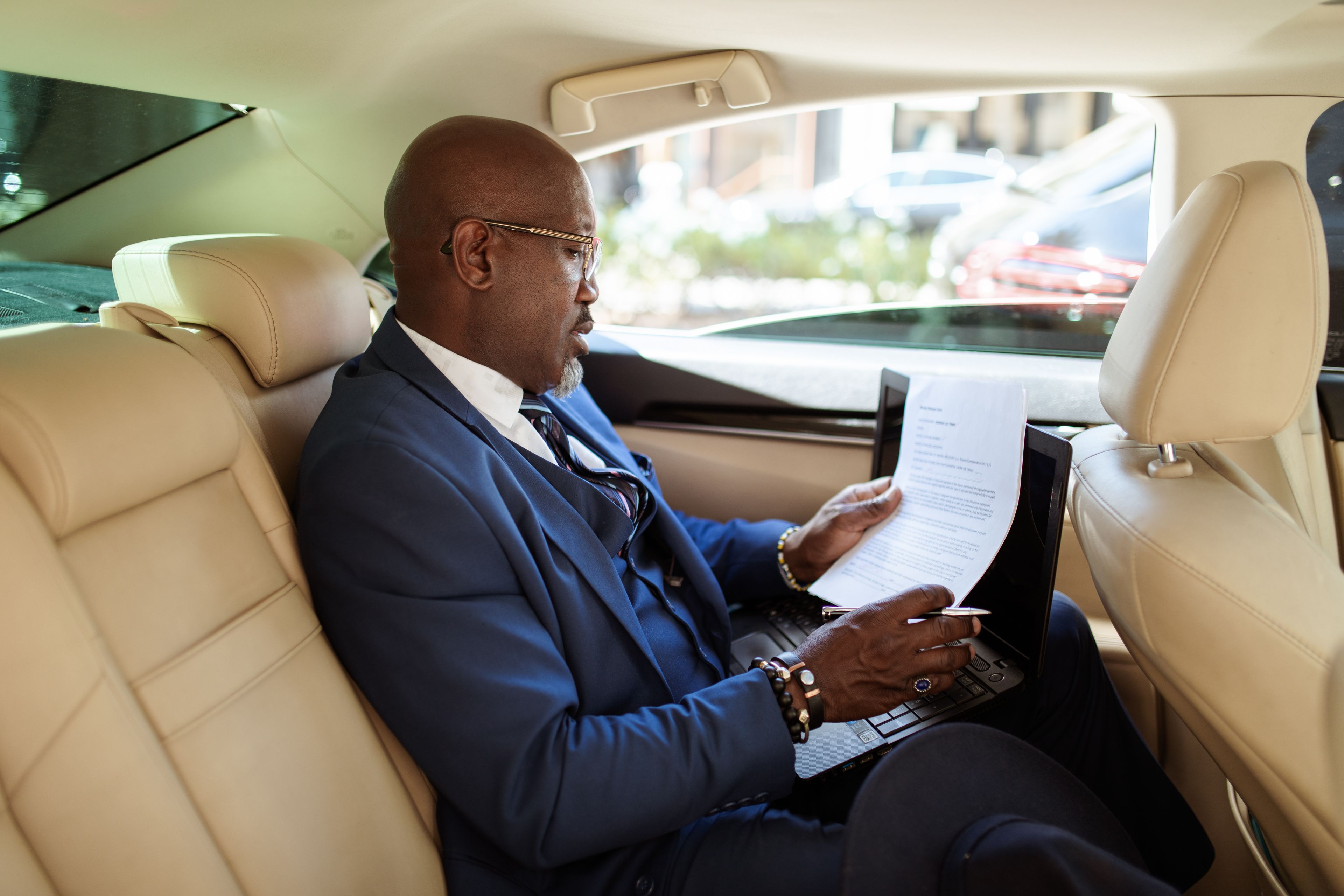
A professional chauffeur will work out within the first half minute whether you want conversation, and behave accordingly for the rest of the journey. It is a learned skill rather than a personality trait. If you get into the car with a laptop already open, you will be driven in silence. If you ask about the traffic, you will get a proper answer and probably a decent conversation.
You are not obliged to signal any of this explicitly, though there is nothing wrong with doing so. Saying that you have calls to make, or that you would rather not talk, is perfectly polite and is heard as information rather than rudeness. Equally, on a long motorway run at the end of a difficult week, a chauffeur who can hold a conversation is genuinely good company.
Confidentiality is the baseline
Anything said in the car stays in the car. That includes what was discussed on your calls, who else was travelling with you, where you were collected from and where you went. A chauffeur who repeats any of that is not a chauffeur for very long, and the discipline is absolute rather than situational. You should not have to ask for it and you should not have to think about it.
The same applies to what a chauffeur notices. Regular clients are recognised and remembered, and none of it is discussed elsewhere. If it helps to say explicitly that a particular journey is sensitive, do so and it will be taken seriously, but the standard applies whether or not anybody mentions it.

Working in the back
The rear of an executive saloon is a reasonable office for an hour and a good one for three. Calls are the most common use, and they work well because the cabin is quiet, the seat is stable and nobody is trying to talk to you. Video calls are viable too, though the background moves and the connection depends on where you are, which is worth mentioning to whoever you are meeting.
A few practical things make the difference between a car that works and one that almost does. Ask for the temperature you actually want rather than tolerating what you were given. Say if you would prefer no music. Mention in advance if you need the car to be somewhere stationary for a call, since a quiet layby at the right moment is easily arranged and impossible to conjure at short notice.
- Say what temperature you want rather than enduring the default
- Ask for the radio off if you are working, it will not offend anybody
- Mention a video call in advance so the route can favour better coverage
- Request a stationary stop if a call genuinely needs one
- Keep a charging cable to hand rather than assuming the car has yours
- Say if you would rather arrive early and sit outside than arrive on the minute
Front seat or back seat
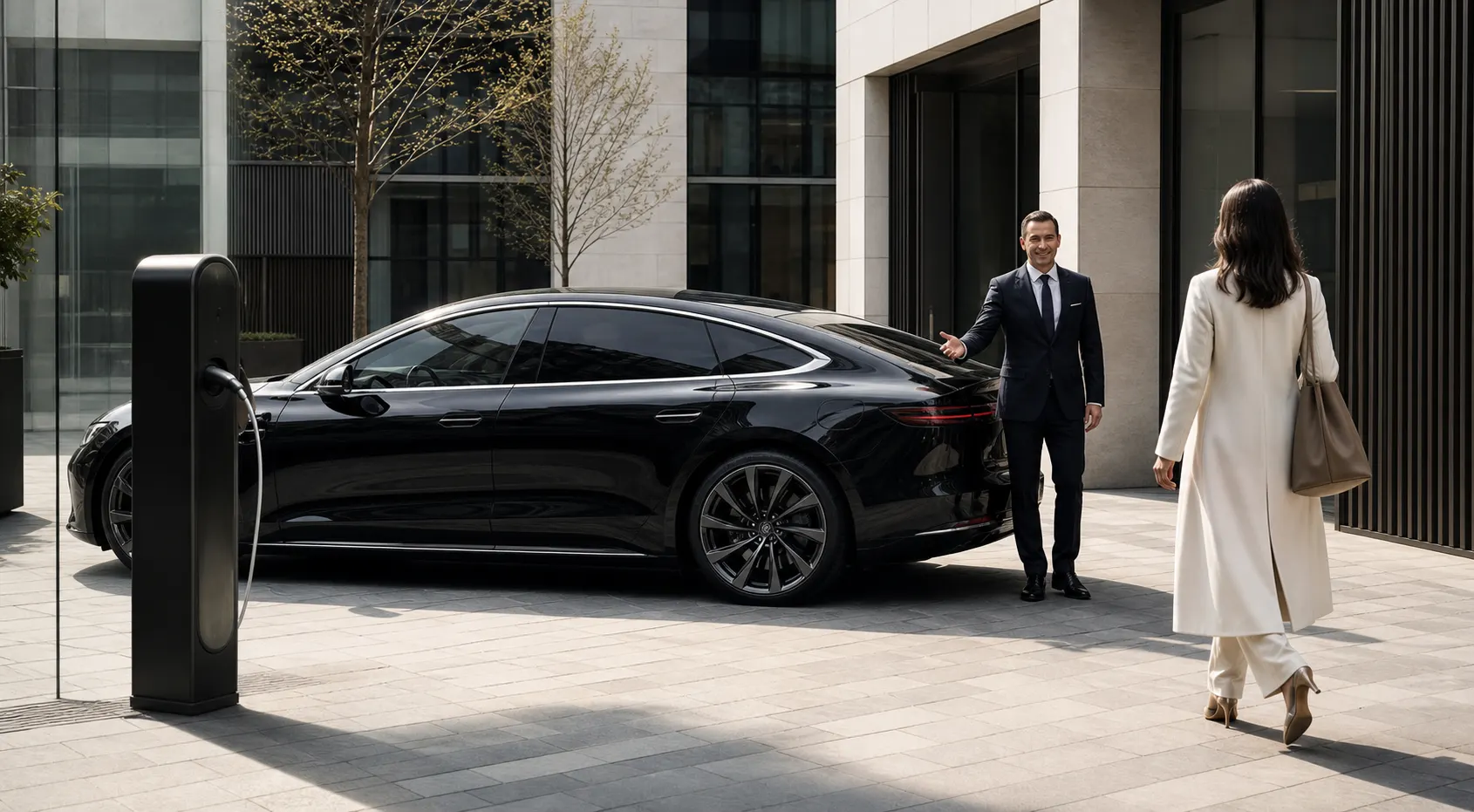
The back is the default and no explanation is needed for choosing it. In a saloon the rear offshore seat, behind the front passenger, is the traditional position because it gives the best view and the easiest exit onto the pavement. If you are travelling with a colleague, the two rear seats are the natural arrangement and the front stays empty.
Sitting in the front is entirely acceptable and some people prefer it, particularly on a long journey or when they want to talk. It is not a demotion and no chauffeur minds. What is worth avoiding is switching seats mid-journey for no reason, purely because it makes the loading arrangement and the door opening slightly awkward at the next stop.
Timekeeping runs both ways
Your chauffeur will be outside ahead of the agreed time, which is the whole basis of the arrangement. The corresponding courtesy is to let us know when your plans slip, and they will slip. A meeting overruns, a flight moves, a dinner runs long. None of that is a problem when it is communicated; it becomes one only when the car is sitting outside an office with nobody able to say what is happening.
A WhatsApp message with an honest estimate is worth far more than an optimistic one. Twenty minutes late is easy to accommodate. Twenty minutes late four times over is a different day entirely, and if we know early we can restructure it rather than compress everything into the evening and hope.
- Send a message as soon as a meeting looks likely to overrun
- Give an honest estimate rather than an optimistic one
- Say if a stop has been added to or dropped from the day
- Flag a flight change the moment you hear about it
- Tell us if you would rather wait in the car than in a lobby
Gratuities, feedback and asking again
Tipping is not expected and nobody will behave differently if you do not. If a chauffeur has done something genuinely above the ordinary, a gratuity is welcome and gracefully received, but it is a matter for you and not an obligation built into the service. The absence of an expectation is deliberate; nobody should feel they are being assessed at the end of a journey.
Feedback is more useful than money in most cases. If something did not suit, say so, because it can be fixed. And if a particular chauffeur suited you well, ask for them by name next time. We cannot promise availability, since our work is covered by our own cars and a vetted network of professional chauffeur operators, but we will always try, and it is the single easiest way to make repeat journeys better.