







The first time somebody flies privately, the aircraft is rarely the surprising part. The building is. There is no departure board, no queue that gives you a sense of how much time you have left, and no announcement telling you what to do next. For a passenger used to airports, the absence of all that scaffolding can be disorientating rather than luxurious, at least for the first ten minutes.
This page explains what that building is, who runs it, and how the ground transport around it should be arranged. It is written deliberately without naming any particular operator, because arrangements differ from site to site and from flight to flight. We are an independent chauffeur service, so everything here describes the road side and defers to the handler on everything else.
What a fixed base operator does
A fixed base operator, almost always shortened to FBO, is a company providing ground services to private aircraft at an airport. That includes the passenger building you walk through, the handling of the aircraft itself, fuelling, crew facilities and the co-ordination with airport authorities. Several may operate at the same airfield, each with its own building, its own access road and its own way of doing things.
The relationship matters more than the acronym. Your operator, the company running the flight, appoints the FBO. The FBO then controls the passenger experience on the ground, including what vehicles may do. Nobody arranging your car has any standing in that decision, which is why a chauffeur service that speaks confidently about apron access should be treated with some scepticism.
Why it is not a terminal
The building is usually small, quiet and organised around a handful of people at a time rather than a few thousand. There is a reception, somewhere comfortable to sit, and a door to the aircraft side. Formalities are conducted where you are sitting rather than in a queue, and the whole passage from arriving at the door to being on board is measured in minutes rather than hours.
That efficiency is exactly why the ground transport has to be more precise, not less. A commercial terminal is a large buffer that absorbs a late car, an early arrival and a slow security queue without anybody noticing. An FBO has no buffer at all. It hands the timing risk back to you, and the car is where that risk mostly lands.

The vocabulary you will hear
A few terms come up repeatedly and are worth recognising, particularly when your operator asks for something in passing and expects you to know what they mean. None of them are difficult, and knowing them saves a round of clarifying messages at exactly the moment when everyone is busy with something else. Most of them simply describe who is responsible for which part of the day, which is the useful distinction throughout.
When you pass any of these to us, pass them as given rather than paraphrased. The handler name in particular should come across exactly as your operator writes it, because at a large airfield with several operators, a near-miss on a name is as unhelpful as no name at all. Forwarding your operator's message to us unaltered is the simplest way of getting that right.
- Operator, the company running the flight and the aircraft
- FBO or handling agent, the company looking after you on the ground
- Slot, the time window in which the flight is permitted to move
- Tail number, the aircraft registration your handler will recognise
- Crew, the flight deck and any cabin crew, often on separate timings
- Positioning flight, an empty leg flown to bring the aircraft to you
Arriving: what actually happens
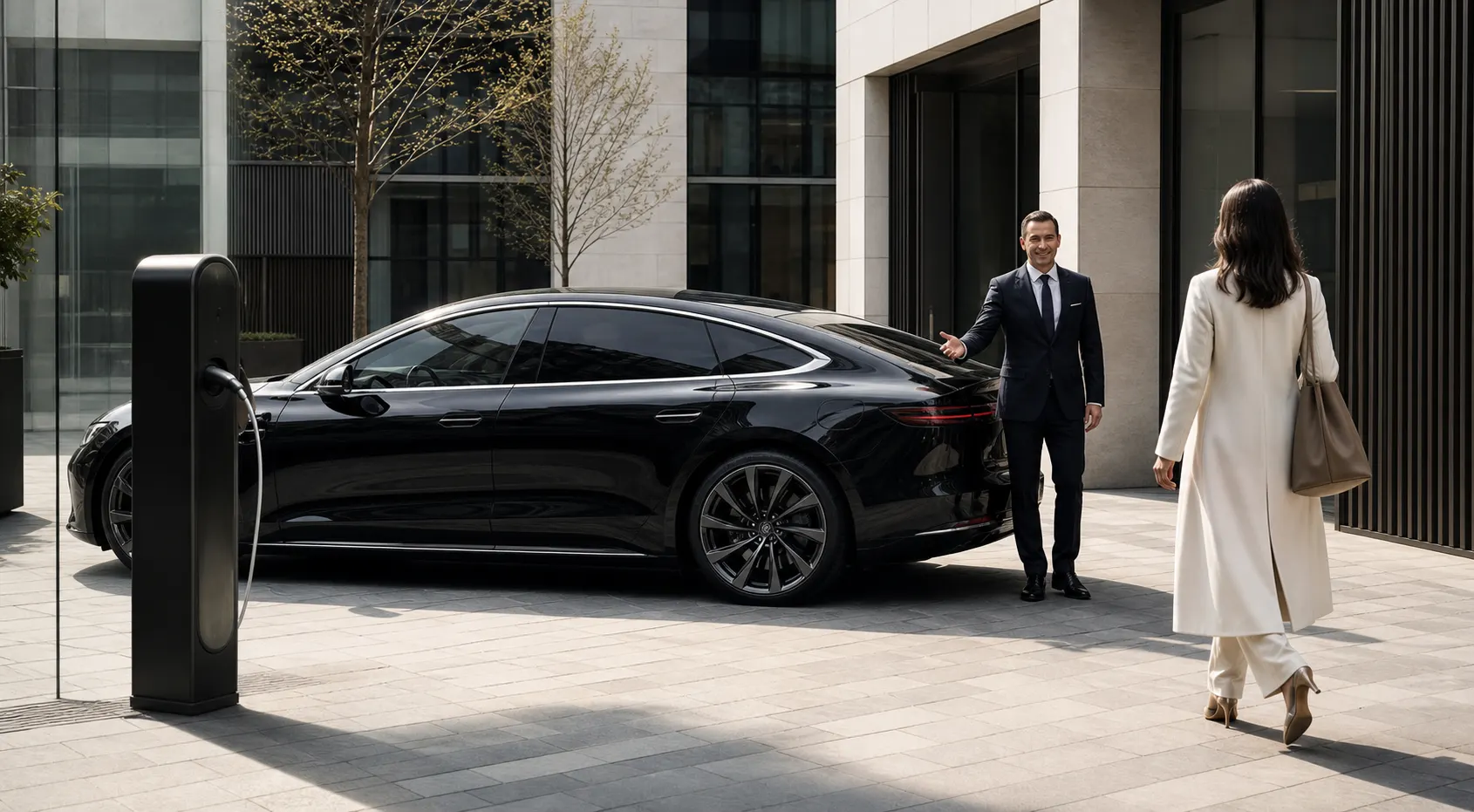
For a departure, you arrive at the building shortly before the aircraft is ready. Your chauffeur will already be there. Bags come out of the car and are taken from you. Inside, someone checks documents, offers you a seat and tells you when to walk out. The interval between arriving and boarding is short enough that people who have allowed two hours are frequently surprised.
For an arrival it is quicker still. The aircraft stops, you walk a short distance into the building, and you are usually outside again within a few minutes. There is no baggage carousel and no immigration hall of the kind a commercial passenger expects, though formalities do still apply and are handled by the FBO. This is why a car that is not already waiting is a car that is late.
Where the chauffeur's role ends
It ends at whatever line the FBO draws, and that line is theirs to move. Some allow a chauffeur into the building to collect luggage and walk passengers out. Some prefer vehicles held at a designated point. A few, at certain sites and on certain days, restrict access more tightly than usual for reasons that are not explained. All of that is normal and none of it is negotiable by a driver.
What we do is ask in advance what applies to your flight, confirm it back to you in writing, and instruct the chauffeur accordingly. We do not offer apron access, airside driving or accompanying anyone through security, and we do not claim to track aircraft. The times you and your operator give us are what the plan runs on, and they have never yet proved insufficient.
Questions worth asking your handler
First-time flyers often assume these questions are somehow impolite. They are not; the FBO expects them and answering them is part of what your operator is paying for. Asking early also means the answers reach us in time to be useful, rather than arriving as a correction while a car is already on the road. None of them takes more than a moment to answer at the other end.
Send the answers over WhatsApp or by email and we fold them into the written quotation covering the vehicle, the timings and the terms. Vehicles come from our own cars and from a vetted network of professional chauffeur operators, so once the constraints are known, matching a car and chauffeur to them is straightforward rather than a negotiation. Nothing is confirmed until you have that quotation and have agreed to it.
- Which building should the car come to, and by which entrance
- How early would you like us to arrive before departure
- May a chauffeur come inside to take luggage
- Where should a vehicle wait, and for how long
- Do you need vehicle or driver details in advance
- Who will confirm the arrival time on the day