




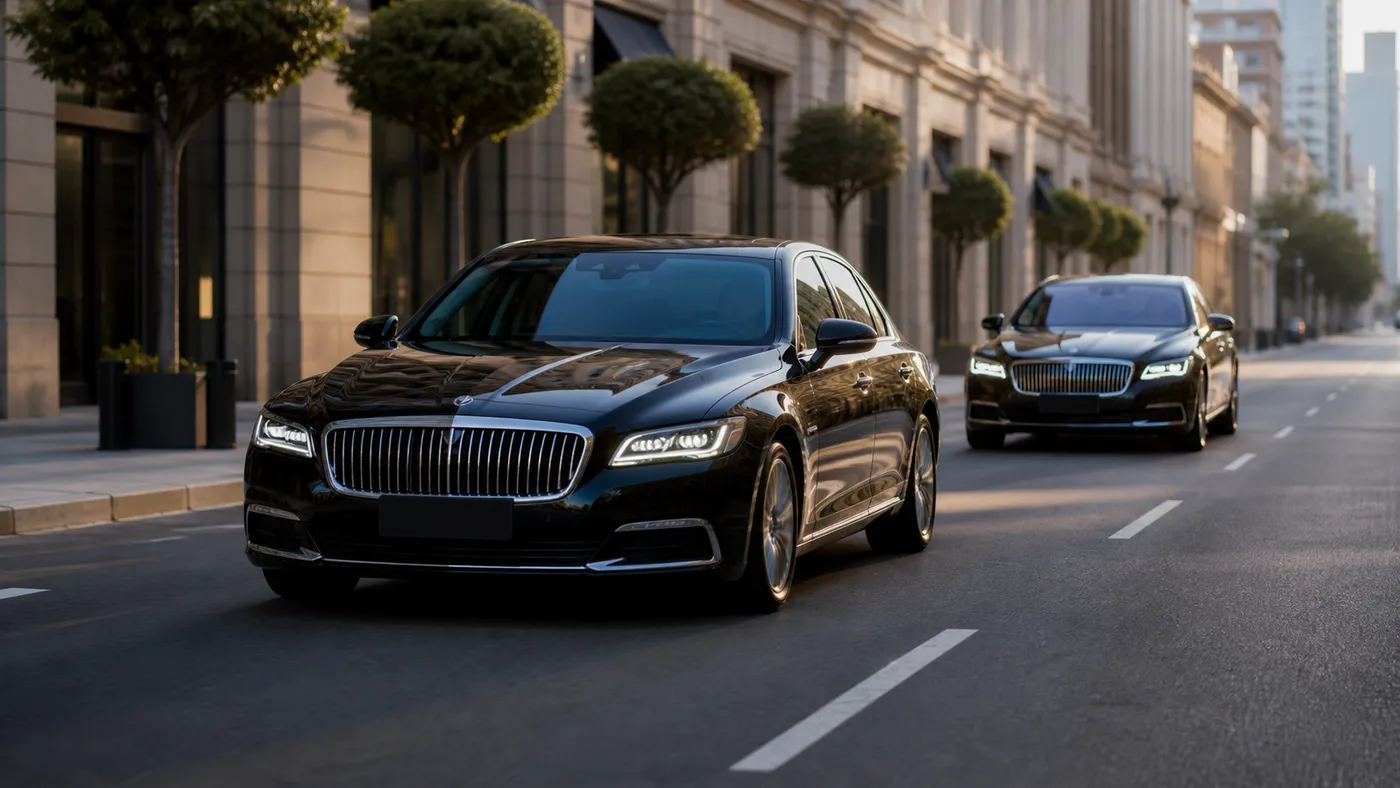




Most descriptions of private jet ground transport skip straight to the part where a car waits beside an aircraft, which is both the least likely outcome and the least interesting part of the arrangement. The work that makes a transfer feel effortless happens days earlier, in the choice of departure time, the sizing of the vehicle and the confirmation of who decides what.
So this is the sequence as it actually runs, written from the chauffeur's side of the arrangement. Some of it will be familiar to anyone who flies privately often. The parts worth reading twice are the ones about boundaries, because a service that is clear about what it does not control tends to be considerably better at the things it does.
The enquiry, and what it needs
It begins with a message over WhatsApp or an email containing rather less than people expect. The date, an outline of the journey, the airfield, the number of passengers and a realistic bag count are enough for a first answer. Everything else can follow, and often has to, because private flight details are frequently still moving when the ground transport is first considered.
What we ask for early is the handling agent, because that single piece of information determines where the vehicle goes and what it may do when it gets there. If it is not yet appointed, we note that and follow up. A quotation without it is still a quotation, but a confirmed transfer without it is a guess, and we would rather not run one.
- Date and the flight time your operator has given you
- Airfield, and the handling agent once appointed
- Passenger numbers and an honest count of bags
- Pickup and set-down addresses at the road end
- Any child seats, mobility needs or pets travelling
- The best contact for messages on the day itself
How the timing is built
Your handler sets an arrival window for departing passengers, and it is typically far shorter than the commercial equivalent. We take that as the fixed point and work backwards. The route determines a base journey time, the hour of day determines how much that inflates, and the character of the road determines the margin we add on top of both.
That last element is judgement rather than arithmetic. A motorway run with one predictable pinch point deserves a different buffer from a cross-London crawl with six. We would rather explain a departure time that sounds early than defend a late arrival, and where our suggestion differs materially from what you expected we will say why rather than quietly accepting the booking.
None of this involves any claim to watch your aircraft in real time. We do not offer flight tracking. The details you share, the operator's schedule, the handler's window and any update from the crew, let us plan around the timings you have been given, which in practice has proved more dependable than a screen showing a dot. It also means the arrangement never rests on a feed that may itself be wrong.

Positioning before you arrive
On the day, the chauffeur aims to be in place before the earliest moment you could plausibly need the car. For a departure that means arriving at the airfield with time to find the correct entrance calmly. For an arrival it means being nearby well before the aircraft is expected, because a private arrival can put you at the door within minutes of the doors opening.
Waiting is not wasted time; it is the product. The whole value of the arrangement is that the delay, whichever direction it runs in, is absorbed by the person being paid to absorb it. A chauffeur who arrives at the same moment as the passenger has been lucky rather than professional, and luck is not something worth building a schedule on.
At the terminal, and who does what
What happens at the building is set by your handling agent, not by us. In some arrangements the chauffeur comes inside, takes the bags and walks you out. In others the vehicle waits in a designated area and you are brought to it. Both are perfectly ordinary. We ask which applies for your flight, confirm it to you in writing beforehand, and work to it exactly.
We do not promise apron access, airside driving or escorting anyone through security, because those are not within our authority to offer. Nor do we take part in documentation, screening or anything else on the controlled side of the building. Our responsibility begins and ends with the road, and stating that plainly is more useful than an impressive claim that dissolves at the gate.
When the plan changes mid-day
Private flying moves. A slot slips, weather closes an airfield, a meeting overruns, an aircraft goes technical. The measure of a ground arrangement is not whether it survives a perfect day but how quietly it absorbs an imperfect one. A message to your chauffeur is enough to move a collection, and we would far rather hear about a change early than have a car sitting somewhere useless.
Where a change is large enough to alter the destination, we rebuild the plan rather than adapting it. That may mean a different vehicle, a different chauffeur or a different route entirely, and all of those are easier with warning. Cars come from our own fleet and from a vetted network of professional chauffeur operators, which is what makes a same-day rebuild possible at all.
Onward journeys and holding a car
The transfer rarely ends at the terminal. Onward journeys from a private airfield run to houses, hotels, meetings and, quite often, to somewhere well outside London that would be a poor use of a taxi. Telling us the onward destination at the point of enquiry changes the vehicle recommendation more often than the airfield does, and it is the detail most frequently left until last.
Where a day involves several movements, holding a car and chauffeur for a half or full day is usually calmer than booking separate transfers. You gain flexibility around a schedule that may move, and the same chauffeur carries the context through the day. It is the arrangement we suggest most often for private aviation clients, and rarely the one first asked for.
- Single transfer, for a straightforward arrival or departure
- Return pairing, where the outbound and inbound differ in traffic terms
- Half or full day, where the schedule is likely to move
- Passenger car with a second vehicle following for luggage
- Separate crew vehicle on its own timing
- Convoy of matched vehicles for a group arriving together