






Some airports need a guide because they are complicated. Liverpool John Lennon needs one because it is so straightforward that people over-plan it. A single compact terminal at Speke, arrivals opening close to the front of the building, and a car park a short walk away add up to the least fussy collection in the north west.
That does not mean nothing here is worth knowing. The clearing times are genuinely quick, which changes how a chauffeur plans the wait. The roads around Speke and the Mersey crossings have their own habits. And the onward journeys from this terminal are often longer than the transfer into the city. All of it is covered below.
A terminal you can cross in a minute
There is one passenger terminal, and it is small enough that the entire arrivals process happens within a short distance of the entrance. You come through from reclaim into a concourse that opens more or less onto the front of the building, with the exit visible from where you emerge. A name board is impossible to miss in a space this size.
The practical consequence is that the meeting takes seconds rather than minutes. There is no march across a hall, no set of competing exits and no confusion about which doors your party came out of. For anyone arriving late at night or travelling with children who have run out of patience, that compactness is worth more than any facility.
How quickly the airport clears
Liverpool is generally quicker to leave than its larger neighbours, which is one of the reasons people choose it. On a European flight with cabin bags, twenty minutes from touchdown to the front of the terminal would not be unusual on a quiet evening. With hold luggage, add to that, since reclaim is the slow step here as it is everywhere else.
The airport runs a substantial low-cost programme, so arrivals tend to come in waves rather than steadily through the day. When two or three flights land close together the concourse fills quickly and then empties again just as fast. Half an hour with bags is a reasonable working figure across most of the published schedule.
Your chauffeur is in position from the point your flight is expected on stand and waits from there, so a quick clearance and a slow one are handled identically. Providing the flight number lets us plan around the published schedule and the clearance times we would ordinarily expect here. That is planning; we make no claim to track aircraft in real time.
Where the car is left
The short stay parking sits close to the terminal, and because the site is small the walk out is genuinely brief. There is no lengthy covered corridor to negotiate and no need to cross a road system with a trolley. If you have flown in on the last arrival of the evening, this is the sort of detail that matters more than it should.
Set-down and pickup on the forecourt run under the airport's own arrangements, and they are chargeable. We handle whatever applies on the day and include it in the written quotation, so nothing is settled at a barrier. If you would rather be collected from a named set-down point than met inside, we can arrange that, though at this airport there is little to gain from it.
- One compact terminal at Speke on the north bank of the Mersey
- Arrivals opens close to the front of the building
- Short stay parking within a short walk of the doors
- Flights arrive in waves rather than steadily through the day
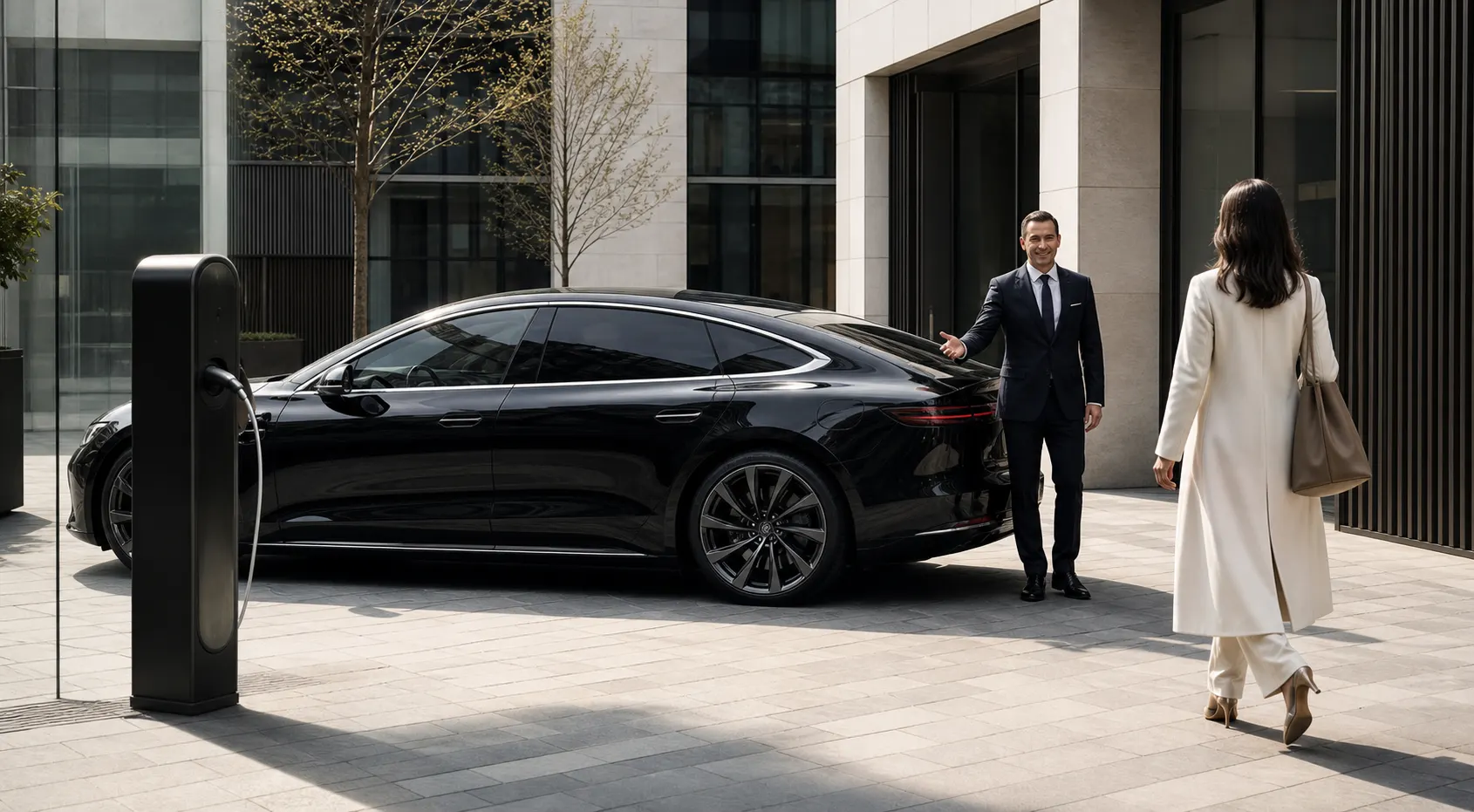
- Your chauffeur waits inside with a name board and takes the cases
- Nothing here involves a shuttle bus or a long internal walk
The roads out, including the crossings
The A561 runs along the river from Speke into the city and is the usual approach, with the M62 and M57 doing the work from further afield. Into the centre the drive is ordinarily twenty to thirty-five minutes, and the dock road end of it slows in the evening rush in a way that surprises people arriving from quieter places.
For the Wirral, Chester and North Wales, the Mersey crossings are the variable. The tunnels have their own peaks and their own occasional closures, and the bridge upstream is not always a faster answer. Your chauffeur will decide which to use on the day rather than committing to one in advance, because the right answer changes by the hour.
- Liverpool city centre, twenty to thirty-five minutes on the A561
- Chester, a short and straightforward run
- The Wirral, by whichever Mersey crossing is behaving
- North Wales, the coast road and Snowdonia beyond it
- Southport and the Lancashire coast to the north
- Manchester, when a connection makes it necessary
Details that decide the vehicle
Since the terminal question does not arise, luggage does most of the work in shaping a booking here. Give us the number of large cases and cabin bags honestly, including the one that gets added at the last minute. A group of four with a fortnight of holiday luggage needs a different car from four business travellers with cabin bags, and the difference is not marginal.
Beyond that: flight number and date, passenger count with ages for any child seats, a mobile number that works on landing and the full onward address with a postcode. If golf clubs, instruments or anything else awkward is travelling, say so plainly. Vehicles come from our own cars and from a vetted network of professional chauffeur operators across Merseyside and Cheshire.
Late arrivals and the last flights
The evening arrivals are a large part of this airport's schedule, and a late landing is completely ordinary rather than a special arrangement. Your chauffeur is there for the last flight of the night as readily as for the first of the morning, and the compact terminal means you are in the car within minutes of clearing customs.
If a flight is delayed into the small hours, the collection moves with it and nobody needs to renegotiate anything. Send a message when you know something. Everything is arranged over WhatsApp or email, so there is a written record of what was agreed, and the terms covering waiting and changes are set out in the quotation before it is confirmed.