



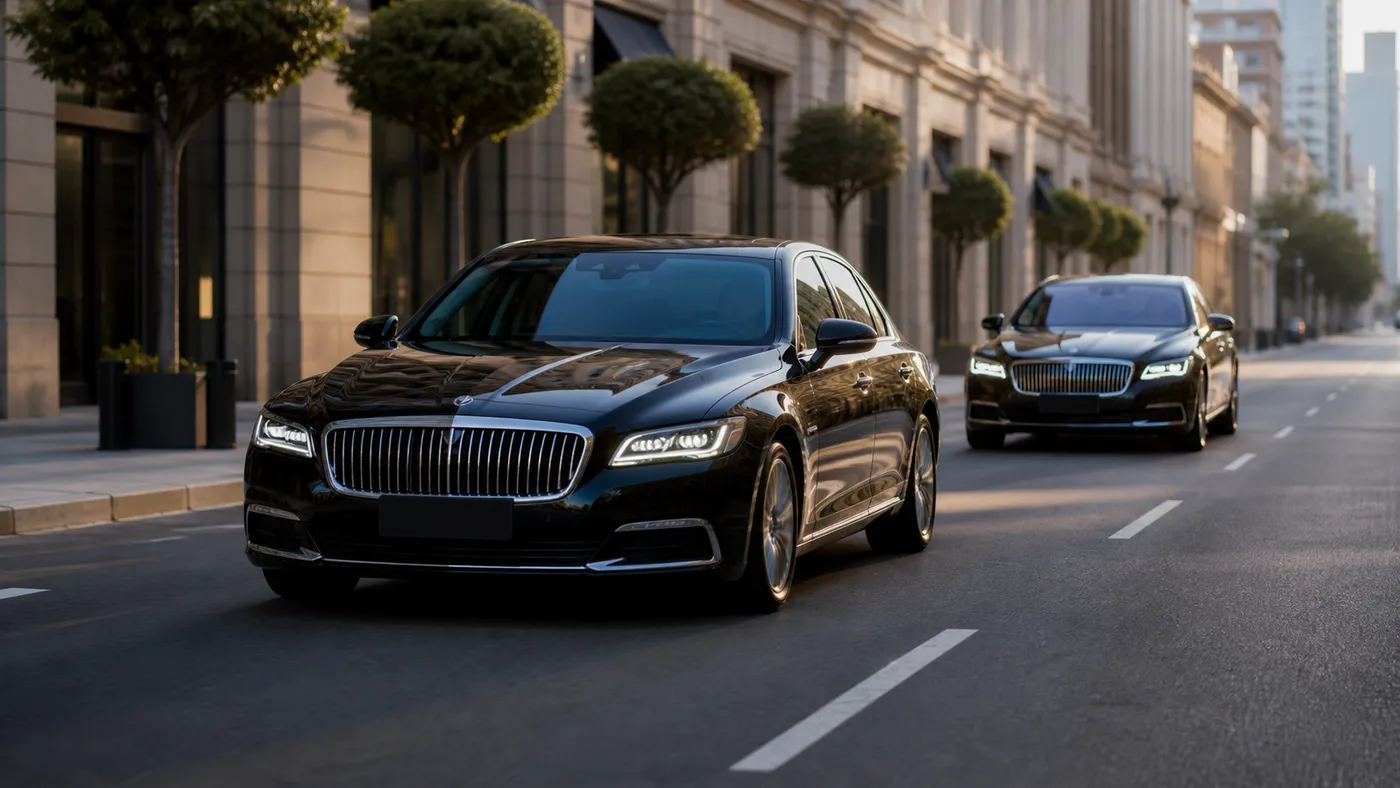


Darkness changes a journey more than most people expect. The roads empty and the miles come easier, but the margin for error narrows: fewer places are open, fewer people are about, and a wrong turn at two in the morning feels considerably less trivial than the same wrong turn at noon. Night work rewards planning and punishes improvisation.
It is also when a chauffeur earns their keep most obviously. Nobody wants to be looking for a taxi outside a venue at one in the morning, or driving themselves home after a dinner that ran long. Here is what a night booking involves, which journeys make up most of our after-dark work, and what to settle when you enquire.
What changes once it gets dark
The driving itself is the smaller part. Fatigue management matters more, so a chauffeur working a late finish is not also starting at dawn, and a night that runs long is planned with that in mind rather than discovered halfway through. Routes are chosen differently too, favouring lit roads and sensible stopping places over the shortest line on a map, and overnight closures on the motorway network are checked before the car leaves.
Waiting is different as well. A chauffeur holding for you outside a restaurant at eleven has fewer legal places to stop than the same car at three in the afternoon, and a good many city centres restrict standing after dark. It rarely causes a problem, but it is the reason we ask where you will actually come out and whether the venue has somewhere a car can sit without being moved on.
The journeys that fill the small hours
First flights account for a great deal of it, with collections from home long before sunrise and motorway runs to the airports while the roads are still empty. Late arrivals are the mirror image: a long-haul landing near midnight, a family walking out into an empty terminal, and a car already there. Both are among the most straightforward bookings we handle, because the timing is fixed by somebody else.
The rest is social and professional. Theatre and dinner, a wedding party that finishes when the band does, a hospital discharge at an awkward hour, an overnight business trip where the meeting ends late and the return cannot wait until morning. What these have in common is an end time nobody can predict precisely, which is exactly why an hourly or full-evening arrangement usually suits them better than a fixed one-way booking.

Arranging a night booking well
Notice matters more after dark than it does at midday. Fewer chauffeurs are working, and a request for a particular car at four in the morning on a Sunday is a genuinely harder ask than the same car on a Wednesday afternoon. We will always tell you honestly whether it can be done for your date rather than accepting first and scrambling afterwards.
Beyond that, the useful detail is unglamorous. Send us the items below when you enquire and the night can be planned in a single exchange rather than three, which matters because arrangements made after midnight are much harder to correct than arrangements made the week before. If the finishing time is genuinely unknowable, say so — an open end is easier to plan for than a guess that everybody quietly knows is wrong.
- The realistic finishing time, or an honest admission that there is not one
- Where the car should wait, and whether the venue permits it
- Whether anybody is being dropped home separately afterwards
- Any address that is hard to find or poorly lit at night
- Whether the same car is needed again the following morning