



Ask what a Defender carries and the useful answer is not a suitcase count but a description of the shape. The load bay behind the second row is tall, square-sided and flat-floored, with almost no intrusion from wheel arches at the top of the space. That geometry is why it takes things that defeat vehicles with far larger quoted capacities.
It is also a vehicle with two genuine quirks that affect loading: a rear door hinged at the side rather than the top, and a spare wheel usually mounted on the outside of that door. Neither is a problem, but both change where the vehicle can be parked for loading, so they are worth understanding before the morning of a trip.
Capacity with five seats in use
With the second row occupied and no additional seats fitted, four large checked cases and three cabin bags is a load we are happy to commit to. The cases stand upright against the seat backs, which uses the height properly, and the softer bags fill the top of the space where a saloon would already be full.
Push beyond that and things stay workable for a while. Five medium cases and a few holdalls is comfortable. What breaks it is not volume so much as passenger count, since a full complement of five people means no seat can be sacrificed to overflow and everything has to go behind the second row.
Occasional seats change the picture
Some vehicles carry a pair of fold-up seats in the load area. When they are stowed you would barely know they are there. When they are in use, the load bay behind them is reduced to a shallow slot suitable for a few soft bags and not much else, and a full holiday load simply does not fit.
This is the single most common misunderstanding with the Defender. Seven seats and seven people's luggage are not available at the same time. If your party genuinely needs both, we will recommend a luxury MPV or a second vehicle, and it is much better to establish that at the quotation stage.
The rear door and where you park
The rear door swings outwards on side hinges rather than lifting overhead. That has one advantage and one constraint. The advantage is that it works in a low-ceilinged garage or barn where a tall tailgate would foul the roof. The constraint is that it needs a clear arc behind and to one side of the vehicle.
In practice your chauffeur simply positions accordingly, leaving space at the rear rather than reversing tight to a wall or another car. It is worth knowing if you are directing a collection in a narrow drive or a tight courtyard, because it takes a few seconds of thought at arrival rather than a manoeuvre once everyone is standing there with bags.
Loads it takes that saloons cannot
This is the reason clients pick the Defender for country and sporting trips. The shape of the space and the durability of the surfaces mean that things which would be unwelcome elsewhere are entirely routine here.
- Gun slips, cartridge bags and shooting kit, subject to all legal requirements
- Fishing rod tubes and landing nets laid along the floor
- Wet outdoor clothing, boots and waders that would ruin a carpeted boot
- Dog crates and travel beds where a guard is fitted to the vehicle
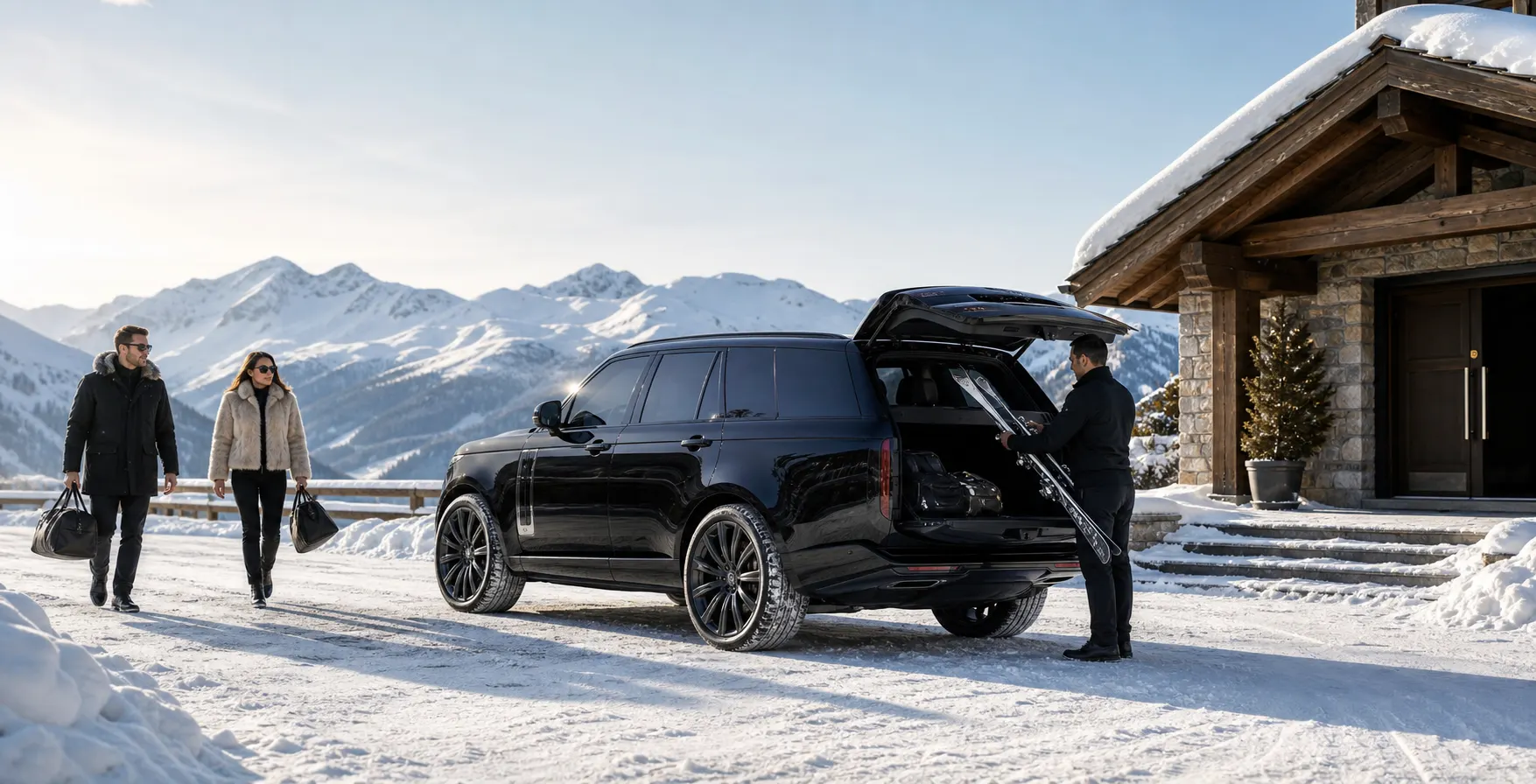
- Skis, poles and boot bags, carried inside without folding a seat
- Camera cases, tripods and location equipment stacked upright
Practical loading notes
The floor sits high, which is the price of ground clearance, so heavy cases involve a proper lift. Air-sprung vehicles can usually be lowered at the rear to help. Your chauffeur handles the luggage in any case, but it is worth knowing if you intend to load something particularly heavy yourself.
Two smaller points that come up. There is often a load-space cover or a fitted guard which sets a firm ceiling on stacking, and a spare wheel mounted externally adds a little length to the vehicle, which matters in short parking bays. Neither affects capacity but both affect how the vehicle is positioned.
Telling us what is coming
For sporting and country trips, describe the equipment rather than counting bags. Rod tubes, gun slips, dog crates and boot bags all have shapes that a case count fails to capture, and knowing about them lets us assign a vehicle with the right configuration and, where appropriate, the right protective covers fitted.
Vehicles are supplied from our own fleet and from a vetted network of professional chauffeur operators. Body style, seat count, suspension and interior specification vary between examples, are subject to availability, and are confirmed when your booking is confirmed rather than assumed at enquiry.