






Every traveller with a driveway eventually weighs this up. Drive to the airport, park somewhere for the duration, and drive home at the end. Or be collected at the door, delivered to the terminal, and met again on return. The two are usually compared on outlay alone, which misses most of what separates them: the shape of the day at each end, and the state you are in when you reach it.
This page describes both arrangements properly, including the parts of the parking option that people forget when they are estimating it: the drive itself, the transfer bus, the walk with luggage, and the return leg at the worst possible hour. It also says clearly when parking your own car is the sensible decision, because for a large number of trips it plainly is.
The real shape of a parking day
Parking begins earlier than the drive suggests. You leave with a larger margin because you must now find the car park, negotiate the barrier, unload in a bay, and cross to a bus stop. On-site long stay usually means a shuttle of ten or fifteen minutes with luggage on and off. Off-site parking means a longer transfer and, at busy periods, a wait for the next bus with everybody else who had the same idea.
The return leg is where the arrangement is felt most. After a long-haul flight, having cleared immigration and collected bags, you walk to a bus stop, wait, ride, find the row you parked in, load, pay if you have not already, and drive home. That is often an extra hour, sometimes more, and it lands at exactly the point in the journey when you have the least left to give.
Two drives you make yourself
The outbound drive is the manageable one, though it carries the full weight of the traffic risk. A poor morning on the western M25 or a closure on the M23 spur is stressful when the flight is fixed and you are the one making the decisions about which junction to leave at. There is nobody to hand that problem to.
The homeward drive is the harder proposition and the one worth thinking about most carefully. Driving after a long flight, a short night or a time-zone shift is genuinely tiring, and tiredness at the wheel is the single most serious argument against the whole arrangement. Many people who park regularly will admit that the drive home is the worst part of the trip, and they are right.
What happens to the car in between
A vehicle standing outside for two or three weeks is a small collection of minor risks: a flat battery in winter, tyres that have gone soft, ice or frost to clear at midnight, a dead key fob, and the occasional dent that nobody can explain. Reputable car parks are secure and most trips pass without incident, but the risk is not zero and it is entirely yours.
There is also the opportunity cost at home. A car sitting at an airport is a car not available to a partner, a family member or a household for the entire duration. For a single traveller this is irrelevant; for a family with one vehicle it can be the deciding factor, and it is worth counting before comparing anything else.
The two arrangements side by side
Reduced to the elements that actually differ, the choice becomes reasonably clear. Weigh these against your own trip rather than in general, since the same traveller may sensibly park for one journey and book a car for the next. Duration, the distance from your home to the terminal, and the hour at which you land on the way back do most of the deciding between them.
- Total outlay: parking is nearly always the cheaper arrangement
- Time at the departure end: a chauffeur removes the shuttle and the walk
- Time on return: parking adds a bus, a search and a drive when you least want it
- Driving tired after a long flight: the strongest argument for being collected
- Household use of the car while you are away: preserved by a transfer
- Luggage handling: loaded once with a chauffeur, several times with parking
- Flexibility if the flight is delayed: the booking adapts, the car park does not
- Short trips from a nearby home: parking is hard to beat
When parking is genuinely the better plan
For a short trip from an address close to the airport, parking usually makes the most sense. If you live twenty-five minutes from the terminal, are away for two nights with hand luggage, and are returning at a civilised hour, driving and parking is quick, cheap and involves nobody else's schedule. Booking a car for that would be an indulgence rather than a solution.
It also suits travellers who fly very frequently on the same route. If you are at the airport most weeks, the routine becomes second nature: the same car park, the same row, the same bus, no thought required. Familiarity removes most of the friction that makes parking tiresome for occasional travellers, and the cumulative saving across a year is substantial.
And it wins whenever your plans are genuinely uncertain. If you may return a day early, or may drive straight on to somewhere else, having your own car waiting gives you an independence no booking can match. We would rather you parked and kept that freedom than booked a return transfer you might need to move twice. Independence at the far end has a real value that a quotation cannot show.
How a transfer is planned instead
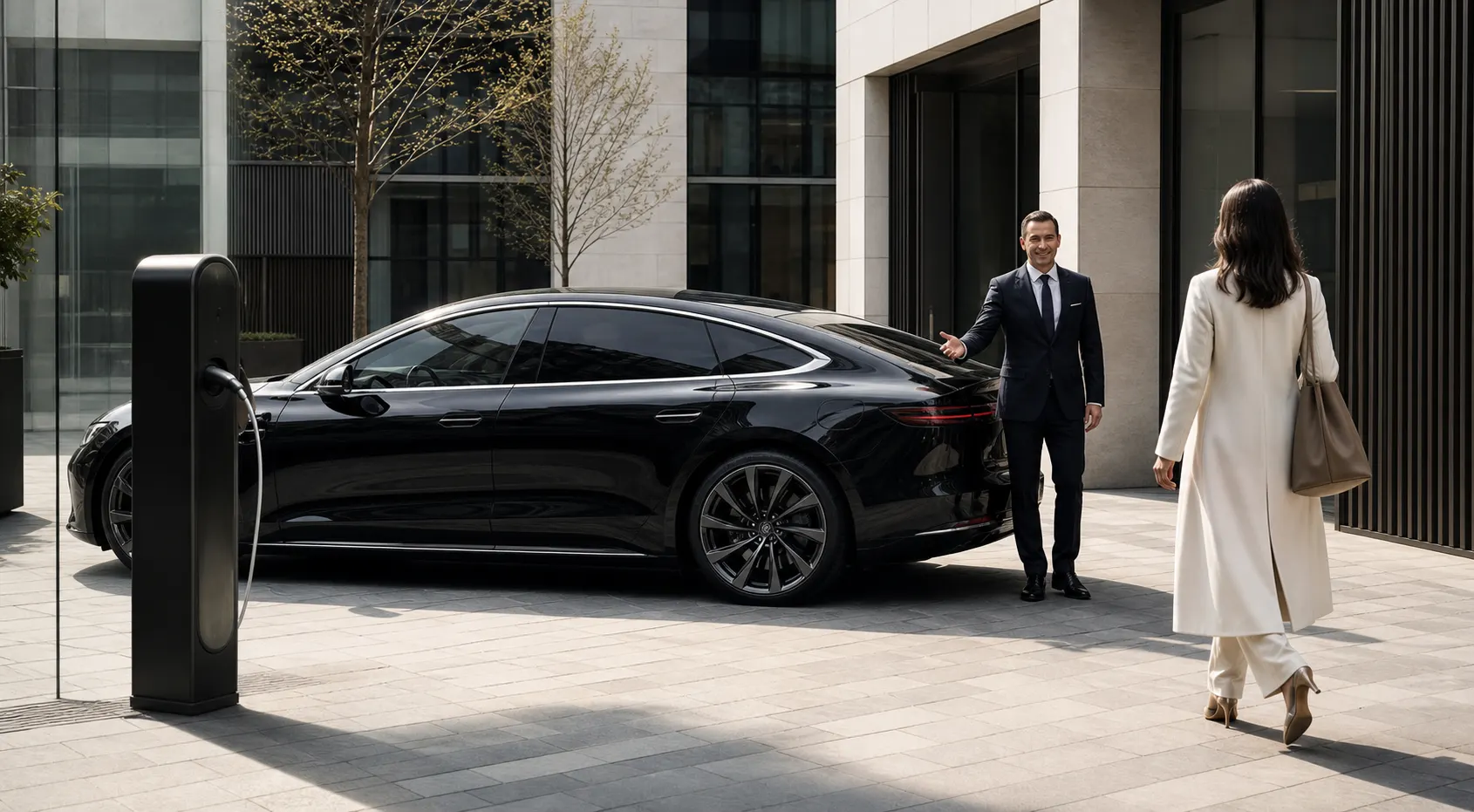
Where a chauffeur is the right answer, the outbound leg is planned backwards from your check-in time with margin sized to the hour and the route rather than applied as a blanket rule. A departure at eight in the morning from central London gets a far larger cushion than the same departure at eleven, because those are not the same journey however similar they look on a map.
For the return, give us the flight number and the terminal when you book. We plan around the published schedule so that an arrival landing early or a departure brought forward does not catch anyone out, and the chauffeur waits in the terminal regardless of how slow the baggage belt turns out to be. Send the outline on WhatsApp or by email, with your case count, and the vehicle recommendation follows from that.